Dr Rhoda Stefanatos, Researcher Development Specialist for Research Staff at the University of Glasgow, UK, and Dr Anna Pilz, Academic Developer at the University of Edinburgh, UK.

What is research leadership?
Having both been Research Fellows in STEM and in SHAPE prior to our more recent experiences as researcher developers, we start from the realisation that there is no agreed definition of ‘research leadership’ and that there is little to no scholarship into the specifics of research leadership. One of the few theoretical anchor points comes from Linda Evans who, in 2014, proposed the following:
“Research leadership is defined as the influence of one or more people on the research-related behaviour, attitudes or intellectual capacity of others.” (Evans 2014, p46)
Evans’ focus on behaviour and attitudes, in line with the Royal Society’s definition of research culture, highlights the role of Researcher Developers as both developers of research leadership and as themselves research leaders, observing that “research leadership […] is in many respects indistinguishable from researcher development” (ibid. p48).
Extending this, we argue that all colleagues who contribute to “research-related behaviour” can be viewed as research leaders. However, who is seen, recognised, and developed as a research leader, may vary greatly.
Mapping the current training and development provision of ‘Research Leaders’
To gain an understanding of both who is developed as a research leader at UK-based institutions, and how, we developed an anonymous survey. Drawing on our links to the Researchers 14 network of research-intensive HEIs as well as the Scottish Higher Education Researcher Developer Network (ScotHERD), we invited Researcher Developers from 30 UK HEIs to participate in the survey, including our own respective institutions. With a 50% engagement rate and 11 full responses, the data we collected whilst not complete, is representative, allowing us to provide key insights and trends, offer inspiration, ideas and provocations as well as examples of best practice.
Over eight questions we asked respondents to confirm that they offered research leadership development opportunities. We surveyed (1) the format of the development offer, (2) access and how access was managed, (3) the focus of the development offer, and (4) evaluation of the offer. In recognition of this as a developing area of practice, we also asked respondents to share what was on their horizon and encouraged reflections on the development of research leaders, and researchers as leaders.
What did we learn?
The great majority of HEIs have a wide offer of research leadership development opportunities. This comprised activities in formats such as action learning groups, spotlight sessions, coaching and/or mentoring, cohort-based programs and one-off stand-alone workshops.
When we asked about the focus of this offer, responses were wide ranging and dependent on programme aims and target audience, summarised as:
- approaches to leadership (styles; models; theory/frameworks; leadership vs. management);
- research culture;
- people management (recruitment; delegation; conflict; motivation; collaboration; team leadership);
- career development (personality inventories; strategic approaches).
A number of respondents reported that they map their offer to institutional priorities and research strategies, or to an institutional leadership framework.
We probed who is developed as a research leader. All responding HEIs offer opportunities for independent and senior Researchers, from those newly established, to senior leaders in the organisation. Almost all offered opportunities for Postdoctoral Researchers. In contrast, only ca. 50% provided research leadership training for Postgraduate Researchers, and only 10% had a provision inclusive of Research Professional staff. When look more closely at the free-text responses, we find that two main criteria are used to communicate their offer to target audience: career stage (e.g. early career to senior leaders) and role descriptors (e.g. Principal Investigator, Heads of School/Institute etc).
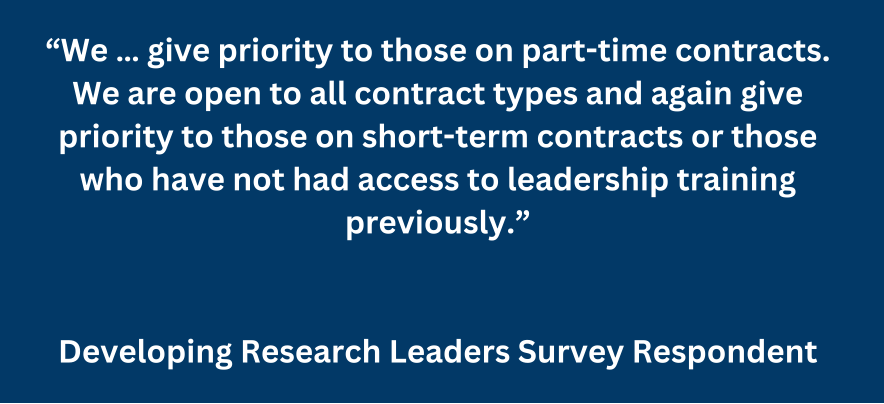
In terms of access management, we identified common trends in relation to the delivery format (e.g. length of programme). Shorter stand-alone sessions were generally offered on a ‘first come, first serve’ basis or, in other words, were widely available for a broad target audience by allowing participants to evaluate the opportunity and self-select to attend. In contrast and unsurprisingly, more resource-intensive opportunities with significant time commitment (e.g. longer, targeted cohort-based programmes, often containing coaching) tend to have application processes in place, often requiring senior sponsorship or nomination. While there will be institution-driven rationales for access management, we expect that this relatively simplistic approach could have unintended exclusionary consequences for who can access opportunities and hence be developed as a research leader. We identified a particular good [KG1] practice example where allocation of places operates on a priority system: “We… give priority to those on part time contracts. We are open to all contract types, and again give priority to those on short-term contracts or those who have not had access to leadership training previously.”
This underlines a need for careful reflection and planning to ensure that all who practice leadership in research have opportunities to develop.
Priorities and provocations
Based on our experiences as Researchers, Researcher Developers and Research Leaders what do we suggest that you could take forward from this survey and our analysis?
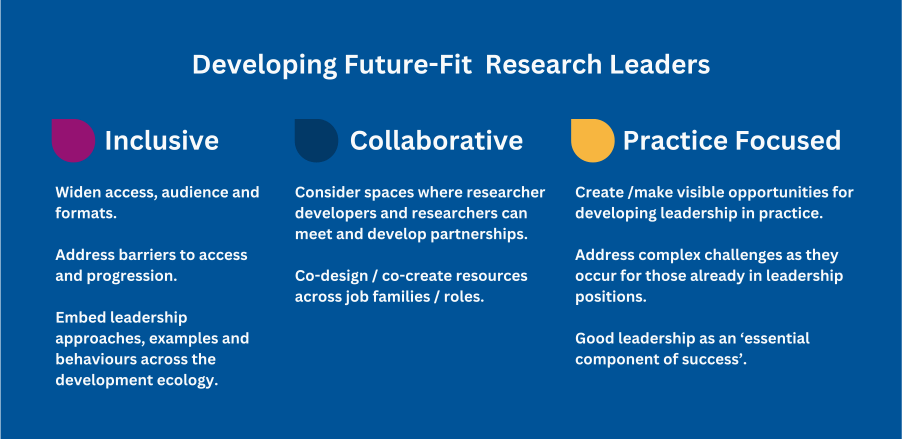
To support the development of leadership in research and research leaders that are future-fit research leadership development needs to be: inclusive, collaborative and practice focused.
Inclusive
An inclusive approach means widening who can be, and who is, developed as a research leader. By taking care to offer different formats with different focuses and context we can address unintended barriers. By embedding leadership approaches, behaviours and opportunities across programmes, Researcher Developers have the opportunity to reframe leadership in research for each audience. For example, asking, what does research leadership look like in different contexts such as teaching-specialist roles? Or, what types of leadership are important when a researcher is early in their career, compared to later?
Collaborative
A collaborative approach enables synergy between the experiences and expertise of key groups, each of whom are developing and practising research leadership. Developers should identify, and if necessary, create spaces which enable partnerships, co-creation and collaboration between Researcher Developers, Researchers and other Research Professional Staff across career stages. For inspiration, look to Bell et al 2024, who advocate for a ‘the more the merrier’ approach to leadership development and the Wellcome-funded InFrame project, a collaborative project led by Glasgow, Edinburgh, and St Andrews that will support production of a single framework for research leadership across role boundaries and enable researchers and research professionals to co-develop projects for catalysing culture change.
Practice Focused
By prioritising the creation of practice and experiential opportunities to lead (and reducing reliance on a ‘training-only’ model) universities can support increased visibility of research leadership. Reconsidering the language used to frame research-related activities such as supervision, or editorial or committee work, can support those at any level to recognise their role in these aspects of research leadership. Offering opportunities that preference practice over theory also supports those facing complex challenges to address them head on and experience leadership in research as a practice on which they can build over time. Recognition of good research leadership practice, as one survey respondent put it, establishes it as an “essential component of success” and incentivises behaviours and values that align with a fair, inclusive and equitable research culture.
Final thoughts
Centring an intersectional and inclusive definition of research leadership allows all those who practice researcher leadership to be included, developed and recognised. It embraces Flinders’ proposed definition in the ‘Research Leadership Matters’ report (2022), moving us from an environment of individual competition to one of community, collegiality and collaboration.
 Researcher Education and Development Scholarship Conference
Leave a comment