Sameera Rafiq, Equity in Leadership Project Officer, University of Leeds, UK. Dr Karen Hinxman, Head of White Rose University Consortium, UK. Nilisha Vashist, Equality, Diversity & Inclusion Manager, University of Leeds, UK.
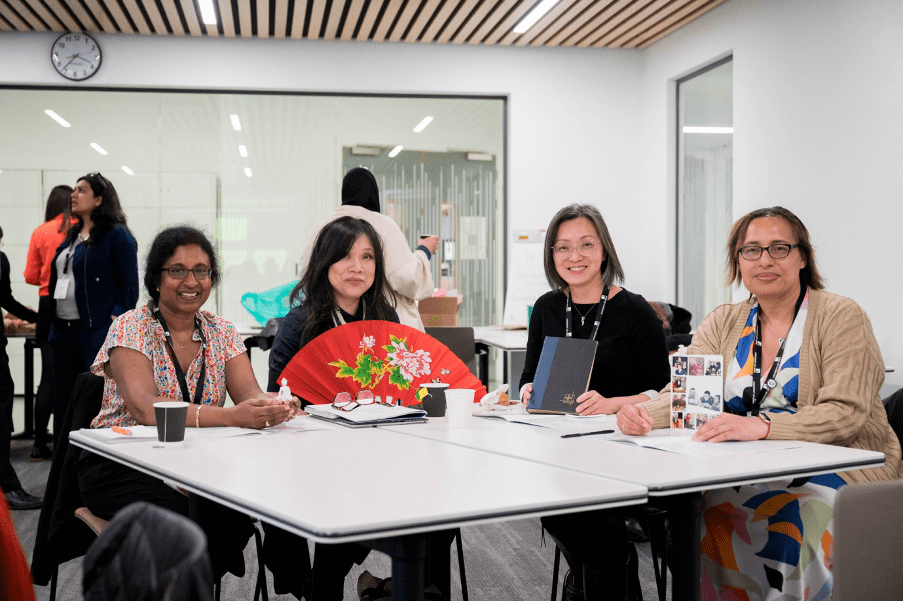
“You can’t be what you can’t see.” These words from civil rights activist Marian Wright Edelman encapsulate a profound truth: the importance of visibility and representation in leadership. For many from global majority* backgrounds (Campbell-Stephens, 2021) this lack of visibility is glaring—especially in UK Higher Education, where senior roles in both academic and professional services spaces are overwhelmingly homogenous (AdvanceHE 2023; Arday 2018; Tate & Bagguley 2017). The challenge is not just one of individual progression, but an institutional challenge: how do we foster a landscape where diverse perspectives don’t just exist, but take the lead?
Turban et al, 2019 in their review found that diverse organisations consistently attract top talent, and those diverse perspectives lead to smarter, more nuanced decisions. Diversity at all levels of an organisation, including the boardroom and executive suite, fosters innovation and supports better outcomes, as people are naturally more inclined to relate to leaders who reflect their own experiences and perspectives. This study couldn’t be clearer: building diversity in senior leadership is no longer just aspirational—it’s strategic. Simply put, the more diverse the decision-makers, the better the decisions.
Yet, for many global majority people, achieving these roles is often a journey marked by additional, invisible barriers. Global majority staff face what is known as the ‘concrete ceiling’ (Otaye-Ebede & Shaffakat, 2024, Davidson, 1997) a thicker, more challenging barrier than what is more commonly referred to as the ‘glass ceiling’. Eagly and Carli (2007) advocate for a metaphor that better captures this reality: ‘the labyrinth’ (Wyatt and Silvester, 2015). Unlike taking a direct pathway, navigating the labyrinth demands persistence, adaptability, and resilience as individuals face dead-ends and twists, constantly seeking new routes forward.
Today, the numbers show just how much work remains to be done. In 2023, only 6.5% of UK global majority academic staff held senior leadership roles, a figure that remains similar in professional services at 7.7% (AdvanceHE, 2023). At the University of Leeds, only 8% of top roles are held by global majority staff, compared to 71% by white staff (Equality and Inclusion Unit, University of Leeds, 2020), perpetuating an ethnicity pay gap that nationally stands at 5.5% and nearly doubles within Russell Group universities (University of Leeds, 2022). These figures underscore the barriers faced by underrepresented individuals.
Leading change through equity in leadership
Recognising the need for innovative solutions to address the issue of senior-level representation, the Universities of Leeds, Sheffield, and York have come together under the White Rose University Consortium to launch the flagship Equity in Leadership (EiL) programme. This initiative centres on a single guiding principle: true leadership equity requires more than just additional training; it requires tailored, intentional support to equip leaders for success. EiL is designed to meet the real challenges global majority leaders face, offering a leadership pathway grounded in inclusivity, personal growth, and mutual empowerment.
EiL is a blueprint for change, developed through a co-created approach with participants to ensure that their needs shape the programme at every step. The programme brings in an award-winning facilitator from a global majority background, along with senior leaders across the three institutions, to guide participants and amplify their voices. Each element is crafted with the understanding that diverse leaders often navigate a different journey—a labyrinth of barriers rather than a linear path to the top.
What makes Equity in Leadership different?
- Collaborative cross-institutional, co-created learning
Following the principles of co-creation in developing transformational leadership (Wahl & Pelser, 2021; Ponce, Pedersen & Sernyak, 2022), the EiL programme is co-created with participants to address their specific leadership challenges and ambitions. The programme reflects the unique experiences, backgrounds, and goals of its participants. An award-winning facilitator and senior leaders from each institution contribute their insights, creating an empowering environment where participants are both supported and challenged. - In-person workshops and senior networking across institutions
Participants attend three immersive, in-person days at each university. These days aren’t just training sessions; they’re a chance to gain clarity, share experiences, and form a supportive community that drives each member’s growth. The networking events with senior leaders across institutions (including the Vice Chancellors), allow introductions that go beyond brief conversations. By connecting with decision-makers, participants gain visibility and develop professional relationships that go beyond the programme. - Personalised support network: coaching, mentoring, and sponsorship
EiL provides every participant with a coach, a cross-institutional mentor, and a sponsor—each support type provides critical allyship in breaking through the concrete ceiling. Studies show that global majority professionals often face an “over-mentored, under-sponsored” (Chow, 2021) phenomenon, which EiL directly addresses. It is active sponsorship that is transformative. Sponsors advocate for participants and connect them with new senior roles, giving them access to opportunities they might otherwise miss. - Peer-led masterclasses to build collective knowledge
Peer led learning is shown to be highly effective for self development in areas of underrepresentation where more senior role-models may be scarcer (Liou-Mark et al, 2018). EiL’s peer-led masterclasses highlight the talent within the cohort and allow participants to share expertise on high-impact topics like strategy, finance, and planning, turning the cohort into a collaborative, resourceful community. This approach builds a unique bond within the group and reinforces the idea that learning flows both ways. - Ongoing alumni community for post-programme support
After completing the programme, participants join a growing alumni network within the White Rose University Consortium. This community is a space for continued and collective learning, mentorship, and advocacy, ensuring that EiL’s influence extends far beyond individual careers and reshapes the culture within each institution.
Driving institutional change: collective action
The power of EiL lies in its ability to bring lasting institutional change, a goal that requires deep commitment from senior leadership. The programme has garnered active support from University Executive Groups, including Vice Chancellors, who have not only endorsed EiL but have also participated in key sessions. Their involvement signals that equity isn’t an add-on; it’s embedded within the institution’s culture.
The programme also supports managers by providing Race Inclusion Training for Managers to ensure that those in leadership roles understand how to foster inclusivity at all levels. And through sponsorship training, EiL helps those leaders move beyond mentorship to actively advocate on behalf of global majority talent. Additionally, carefully curated resources and toolkits support sponsors and mentors on their journey.
The programme also elevates the profile of participants through internal and external campaigns that showcase individual talent. These campaigns highlight real success stories and reinforce the message that diversity drives better outcomes.
Redefining success: belonging as a new benchmark
Promotion statistics are only one measure of EiL’s success. The programme has not yet completed and already nearly one-quarter of participants have earned promotions since joining, a testament to the programme’s impact. But EiL’s ultimate aim goes beyond job titles—it’s about belonging. Participants describe EiL as a ‘transformative’ experience (Chan, 2024), and a ‘revelation’, where their voices are valued and their contributions celebrated. This sense of belonging translates to more than just career progression; it fosters a renewed sense of purpose, community, and empowerment.
As EiL continues to grow, it’s clear that change is happening—not just for individuals, but across institutions (our evaluation is ongoing). EiL is more than a programme; it’s a movement toward inclusive, empowered leadership, setting a new standard for equity in higher education. When diverse leaders rise, they uplift their institutions, enrich their communities, and inspire the next generation to see themselves reflected in places of influence.
*Global majority is a collective term for people of Black, Indigenous, Asian or Latin descent and/or heritage. It is an increasingly popular alternative to racialised minority conception traditionally used in various countries, like BAME in the UK, visible minorities in Canada or person of colour in the U.S.A. Through shifting the focus on what or who is a ‘minority’, it enables a decolonial understanding of ethnicity.
 Researcher Education and Development Scholarship Conference
Leave a comment