Dr Julie Reeves Senior Teaching Fellow, Centre for Higher Education Practice, University of Southampton; Dr Kristin Veighey, Associate Director of Southampton Academy of Research;Dr Kay Mitchell, Senior Programme Manager, NIHR Southampton Biomedical Research Centre; and Dr Sarah Robins-Hobden, Coaching Psychologist and Researcher Development Consultant. Kristin and Kay work directly for the University Hospital Southampton, UK; Julie and Sarah are contracted to work for the hospital.
Effective design of professional development is transformational; training, as Stanley Ross (2018) stated, is one of the ways organisations bring about change. As researcher developers, we have long been concerned with the quality of individuals’ lived experiences – that is in our DNA. Now, however, recognising the impact of the environment on both wellbeing and performance, organisations are also troubled by the quality of their working environment or culture, especially research cultures (Wellcome 2020). This provides opportunities for researcher development to embrace the challenge of cultural transformation.
The novelty of this interest in culture is open to debate; arguably researcher development has always been in the ‘culture change’ business, finding itself on the front line of how people in, largely higher education institutions, do things acknowledging the impact they have on those around them, and helping them to behave differently. However, interest in improving ‘research culture’ is not limited to HEIs – where there is research there will be ‘research culture’, including health care / hospital settings that undertake research. But how far is it possible to drive cultural transformation through researcher development in these complex environments?
Our experience of developing and implementing the Research Leaders Programme at University Hospital Southampton (UHS) indicates that, given a conducive organisational environment, creating a kinder, more inclusive, and more sustainable research culture is possible, although success depends on key factors, and we share five of these below. First, some context.
The Research Leaders Programme was established in 2021 following significant investment from the UHS Trust Board – £4.5 million over 5 years. The programme is for mid-career programme staff across the hospital – consultants and health professionals. It has inclusion at its heart; a doctorate is not a prerequisite to join the programme. Indeed, one of the aims of the programme was to encourage greater involvement and diversity in research. The fifth cohort launched in Spring 2025.
Key factors for creating culture change through developing researchers
1. Aims and objectives
Every programme has aims and objectives, often set by the trainer in collaboration with their clients. The Research Leaders Programme’s, however, were co-designed with researchers, Trust Executive staff and Research Management staff.
The Research Leaders Programme aspires to:
- Balance an individual’s needs and aspirations with those of the programme & wider organisation
- Develop inclusive and compassionate leaders in and from a variety of disciplines – encouraging interdisciplinarity
- Change culture – with participants acting as role models and change agents
- Establish a supportive and enabling environment
- Provide a Return On Investment (ROI) for the programme and sustainable research for participants
- Evidence impact (evaluation from individual to organisation)
To realise these aims, the Research Leaders Programme made provision for protected time, access to existing training from the NHS and University, an Advisor, and bespoke training and coaching as required. Finally, awardees attend a professional development component, a series of leadership gatherings – LaunchPad2Leadership (L2L).
2. Strategic investment and executive commitment
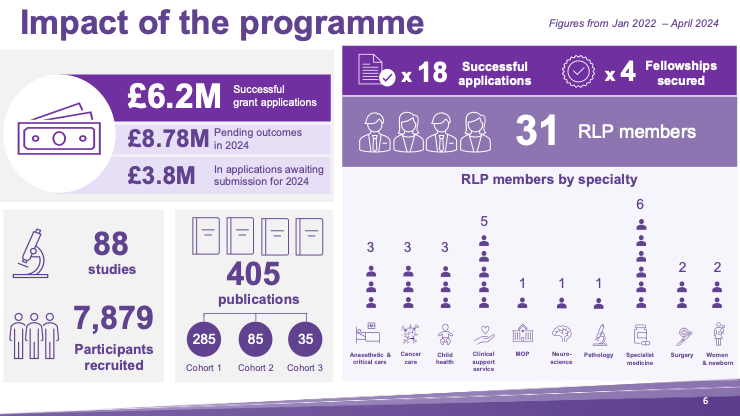
Whilst UHS made a considerable initial investment in the programme, (see diagram below), this has been rewarded in terms of ROI and outputs. In a two-year period, the programme generated £6.2 million in grants, 405 publications, and 88 studies from 31 participants.
This level of investment is clearly not an option for organisations facing financial constraints. However, what has proven most impactful has been the protected time (usually one day a week) and L2L. All participants have valued time to think, and this is where the greatest changes have arisen. It is possible, we suggest, for even the cash-strapped to find ways of investing in staff with substantial/regular blocks of protected time and professional support.
3. Build on needs assessments
A thorough needs-analysis was conducted at the outset, not only informing the design of the programme but ensuring it aligned with UHS Trust Board objectives. A desk review, conversations with key stakeholders and interviews with 15 staff provided insights into existing cultural challenges and shaped the design of a programme.
All new awardees and their advisors have a joint scoping meeting as part of onboarding. This affords the opportunity to discuss research plans and areas where personal and professional support, bespoke and expert help might be required. Awardees needs vary and can include requests for specialist mentors, research fellows to carry out data analyses, or advice on funding schemes.
Awardees are encouraged to identify the ‘step-change’ they wish to make at the beginning of the programme, and this is revisited with an annual survey reporting on progress for monitoring purposes.
4. Design to align with strategic intent
UHS’s strategic plans , along with those of NHS England, aim to generate research activity and to develop inclusive and compassionate staff. The Research Leaders Programme aligned with a people-change strategy within the hospital. Unlike many leadership programmes, the programme does not stand alone; rather, it forms part of a pipeline of leadership training. The Research Leaders Programme’s unique contribution is to focus explicitly on research matters, i.e. impact, wider engagement, sustainability of research. Generic leadership courses are additionally available within UHS and NHS addressing conventional leadership issues, such as building followership.
5. Bring in professional coaching
Sessions are facilitated by a Chartered Coaching Psychologist and Consultant. The advantage of this is that behaviours, assumptions, and practice, can be questioned, challenged and explored expertly in the room. Participants are also supported with optional individual coaching as requested. As cultural transformation rests on mindset and behavioural change, we advocate a coaching approach rather than a ‘teacherly’ one.
Final thoughts:
The Research Leaders Programme aimed to identify staff in all clinical disciplines with research leadership potential, and provide them with time, training, personal and professional development to enable them to progress their careers and build research capacity.
Protected time has been the most appreciated element of the programme. However, it has been the duration of three years, the facilitated L2L, and the stated intention of the programme i.e. to develop research capacity in an inclusive and sustainable way, that have proven transformational. We are witnessing cultural transformation through inclusive language and behaviours, and increased confidence in research and leadership, especially among non-traditional researchers. A significant marker is the greater diversity of new applicants, with a 50:50 ratio of medical doctors to health professions in the latest cohort.
 Researcher Education and Development Scholarship Conference
Leave a comment