Dr Elaine Gourlay, Research Culture Specialist (Communities & Collegiality), University of Glasgow, UK.
The role of Research Professionals (Synonyms: Research Managers and Administrators; Research Support Staff; Professional Services) in supporting research is instrumental (Derrick & Nickson, 2014), and yet, as Researcher Developers, we often focus our attention on the development of Researchers in isolation, leaving the essential roles fulfilled by Research Professionals overlooked. This leads to feelings of disparity in esteem within this group, a deficit in the recognition of their pivotal role in research (Byrne, 2023) and a lack of advocacy for them to develop as leaders in their own right.
Recognising this gap in our evolving research culture, University of Glasgow (UofG)’s Research Culture Team established a Research Professional Staff Network in 2023; a Network built by Research Professionals, for Research Professionals.
In this article, I describe the first year of the Network’s activities, with a particular focus on developing a community-led Network Action Plan and offering our members leadership roles within the Network’s Executive Committee, before we reach our final stop – building esteem in Research Professional Staff.
Leg one: Laying the tracks for the Research Professional Staff Network
Our journey began back in 2020 when the Association for Research Managers and Administrators (ARMA) published the outcomes of a survey on Research Culture, which recommended:
- Promoting parity of esteem for Research Professionals
- Recognising the broad range of qualifications and experiences within Research Professional Careers
- Raising the profile of Research Professionals
The first step to putting this into practice at UofG was to hold Café Culture Consultations* individually across our four Colleges and with central University Services. These conversations highlighted that at UofG, Research Professionals wanted:
- Closer integration or alignment across the institution, as they reportedly felt “siloed” from one another
- Greater emphasis on career & professional development, due to a lack of “career progression or promotions process”
- Increased visibility and recognition, feeling that there is a “lack of understanding of [their] expertise” which should be “promoted and made more transparent”
In response to this, we set out to establish the UofG Research Professional Staff Network (RPSN), with the following aims:
- Connect Research Professional Staff across UofG
- Give Research Professionals a greater sense of community and identity
- Support Research Professionals to align their work across different areas of the University
- Provide Research Professionals with a space to share their career development needs
Leg two: The Network’s journey so far
Research Professionals encompass a broad range of individuals within the institution (Veles, Graham & Ovaska, 2023), and so, in order to create a Network which was inclusive, it made sense to first reach out and establish a Steering Committee for the Network’s development that comprised representatives from Glasgow’s four Colleges as well as central University Services.
The Network’s journey so far is summarised below – this brief slide provides the express service, if you will – but for those of you who would prefer to take the scenic route and meander through the finer details of setting up the network, this blog post provides the detailed story.
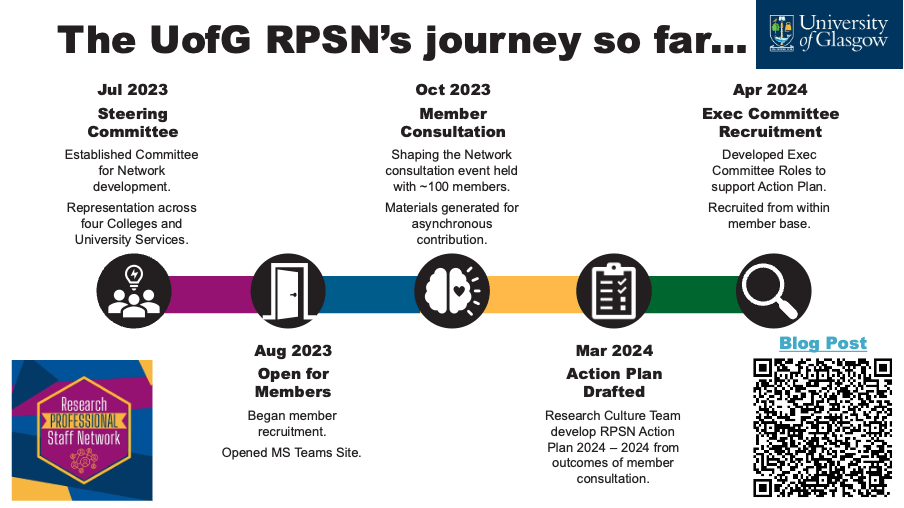
After opening for members in August 2023, the Network’s first event was to hold a Consultation with members to hear their thoughts on how to shape the Network’s activity and impact. Based on the challenges, ideas and thoughts shared by our members, the Research Culture Team devised a five-point Action Plan for the year ahead, focused on the following projects:
- Project 1: Committee development
- Project 2: Networking events
- Project 3: Network communications
- Project 4: Explore options for induction
- Project 5: Develop blog series
With an ambitious plan and multiple areas to progress, we devised eight Executive Committee roles to support the delivery of the Action Plan Projects.
Leg three: Community Leadership
The tagline of the Research Professional Staff Network is that it was build by Research Professionals, for Research Professionals, and we have brought this ethos to the methodology developed for recruitment of our Executive Committee.
Outlines of the eight vacant Executive Committee roles were published within the Network, with full role descriptions clearly outlining the responsibilities and expectations of each post-holder. These roles were open for applications from any member of the Network, asking applicants to provide a brief statement on why they were motivated to apply for the role and what makes them suitable. It was clearly outlined that no experience was necessary, and members were invited to attend a Q&A session where any queries or concerns about the posts, were addressed by the Research Culture Team. This created a safe space for open dialogue about the roles, the action plan and the recruitment process, ensuring that our members felt included, informed and supported to apply.
Applications were collated and the motivational statements from each applicant were published as part of an Executive Committee election campaign – sticking with the spirit of putting the decision of who would lead the Network firmly in the hands of our members. This approach works to instil a sense of belonging and community in our members, in line with Social Capital Theory (reviewed by Bhandari & Yasunobu, 2009), and also links to elements of Self Determination Theory (reviewed by Gagne et al., 2022), bringing with it a sense of empowerment and ownership, supporting our members to feel included and engaged in selecting those who would lead.
Devising a process such as the one described above supports building the esteem of our Research Professionals as we supported their individual and collective voices to be heard, through inviting applications and votes, respectively. This process in itself demonstrated to our Research Professional community that their capabilities as leaders are valued and recognised, their opinions are welcomed, matter and have the power to influence and create change.
Leg four: Inclusion of and welcoming Research Professional Staff within wider provision
In the Research Culture & Researcher Development Team at UofG, we think of our ‘Research Ecosystem’ as being inclusive of Research Professionals, Academics, Research Staff (for example, Postdocs and Fellows) and our Postgraduate Researchers (PGRs). Therefore, it seemed logical that we should include and welcome Research Professionals to our wider programmes of workshops, events, and other opportunities for development. For example, we started to seek opportunities to open up skills development workshops, broaden eligibility for funding calls hosted by our team, or open up mentoring programmes to welcome applications from Research Professionals, the latter of which is outlined in detail below.
The UofG Thesis Mentoring programme pairs PGRs who are actively writing their thesis with a trained and experienced Thesis Mentor. The programme complements the role of the PGR’s supervisor(s) and other specialist support services on offer at the University as it matches PGRs with a Mentor outside of their direct subject area so that the mentoring conversations can focus on writing habits and patterns, rather than research, data and content.
Many Research Professionals are educated to doctoral level and therefore have experience of writing a thesis. As the Thesis Mentoring programme specifically focuses on a PGR’s relationship with writing their thesis (not the content), and is not discipline-specific, we opened the programme to include applications for Research Professionals to become Thesis Mentors in 2024.
Final Destination: Building Self Esteem
Aligning with the wider aims of the Network, the opportunity to become a Thesis Mentor connects Research Professionals with others across the institution and enhances their sense of community and recognises their identity as valued members of our Research Ecosystem with varied experiences and valuable perspectives. With many Research Professionals working with and supporting PGRs through their doctorate, the programme is linked to the UKCGE Recognised Associate Supervision Award, which is open to anyone, including Research Professionals, with a role in supervising PGRs.
Once our first group of Research Professionals had completed the programme, we reached out to them to ask for a short testimonial on what being a Thesis Mentor meant to them. We were delighted with the enthusiasm of responses received and were struck by how inclusion in the programme made our Research Professionals feel valued, see below.
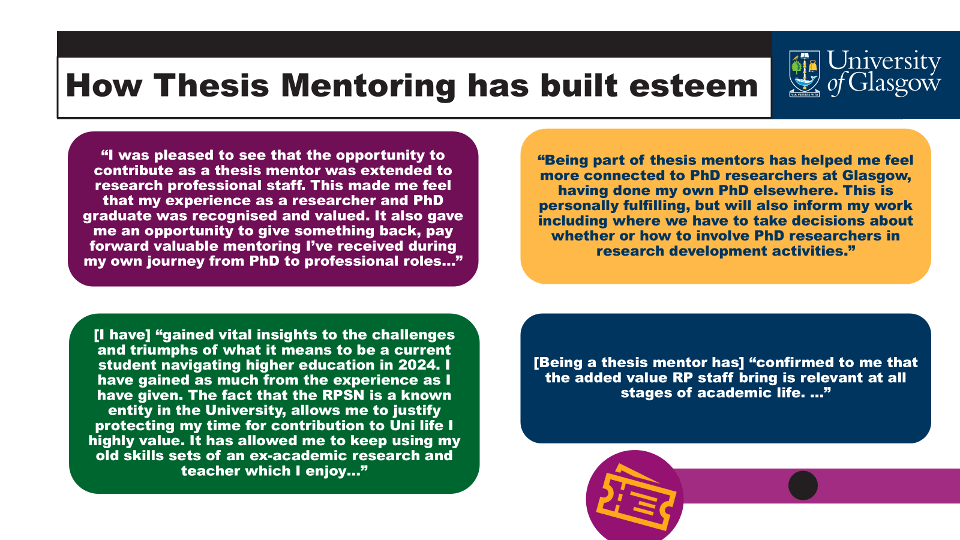
This demonstrates that by making small changes, we can make a big difference towards recognising the expertise and experience of our Research Professionals, raising their profile and visibility within the institution. Together this recognition and visibility has built self-esteem and reframed Research Professionals as leaders in their own right, giving them both an active role and a stake in the evolution of our research culture.
* Our thanks to Dr Elizabeth Gadd for and Ashley Theunissen for their work on the Café Culture events, 2022.
 Researcher Education and Development Scholarship Conference
Leave a comment