By Dr Susan Gasson, Adjunct Senior Lecturer at James Cook University, Australia (ORCiD), and Professor Christine Bruce, Independent Scholar (ORCiD).
This paper is part of the 2026 REDS Conference: ‘Getting creative: shaping a culture of development’
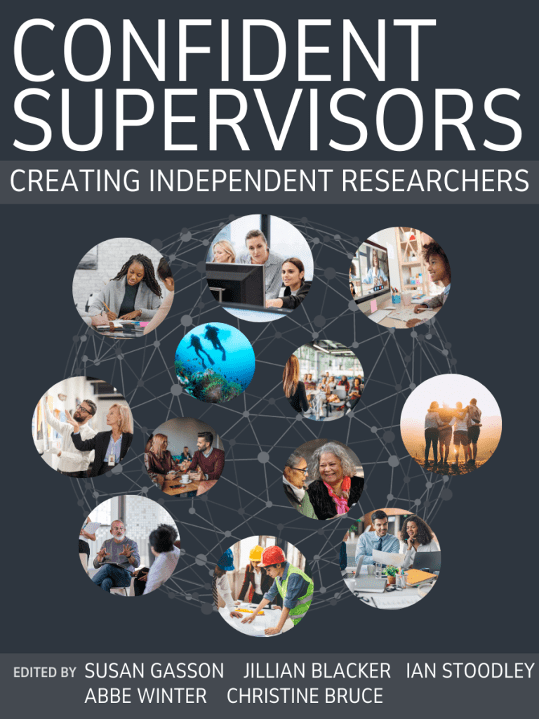
A volume to fill the supervisory practice gap
The critical role of supervisors of higher degree researchers (syn: postgraduate researchers, PGRs, doctoral students) continues to evolve in response to the changing demands of higher education and research. The assumption that being supervised is the best, and perhaps only, preparation for taking on the supervisor role is no longer accepted. As the nature of the higher degree research cohort continues to diversify and the requirements of graduates to prepare for careers beyond the academy become more pressing. Many supervisors are searching for resources to navigate new and unexpected challenges to their practice. In turn, researcher developers are looking for new and creative ways to support supervisors.
As a past Dean of Graduate Studies, and Manager of a Graduate School, supervisor and researcher developer, we conceived of Confident Supervisors – Creating Independent Researchers, open access contributions to fill that void for supervisors globally. Volume 1 of Confident Supervisors features chapters from contributors from around the world all who have personal experience of managing a range of challenges and exploring supervisory practice. The decision to make the book open access aligned with our commitment to providing a resource that was readily accessible to a diverse readership.
Production of Volume 1 was facilitated by the eBook Library team at James Cook University. Their experience of the platform and understanding of eBook readership enhanced the look, feel and readability of the work.
We were surprised by the level of interest met by Volume 1. Edited with Jill Blacker, Abbe Winter and Ian Stoodley, the book stimulated feedback from supervisors in the global North and South looking to enhance their supervisory capacity. Embedding a Google Translate function into the book eighteen months later, with help from library colleagues at Queensland University of Technology (QUT) and James Cook University (JCU), generated a new readership from the non-English-speaking world.
While supervisors, researcher developers and administrators contributed to chapters aimed at informing practice, students’ stories of their doctoral supervision experiences were also highly valued. A key message throughout the volume, was the value of taking a holistic approach to supervision. Supervisors are reminded of the satisfaction associated with supporting a new researcher to shape their identity in the introduction to the Volume 1:
“Academics, in accepting the role, relish the chance to share their expertise, engage with new thinking, and support the creation of the next generation of researchers.”
Further practice examples are provided throughout the volume. For example, supervisors are prompted to consider their role in developing researcher identities in Chapter 6:
“If higher degree researchers learn to read for propositions, structure and evidence, they will be better able to understand the limits of previous research attempts, as well as possibilities that exist within their field. Such an approach also centres the higher degree researchers’ own critical analysis skills and works toward building a scholarly identity.”
And in Chapter 9:
“Help your higher degree researchers understand the importance of developing a professional online identity and share stories (good and bad) from your own career, or from your institution or discipline.”
As Volume 1 continued to attract a strong readership. we were delighted when it won an Open Education Global Award for significant impact. Currently, the global readership exceeds 9,000 people.
What’s coming, in Volume 2 and beyond?
Our success spurred us on to progress preparation of Confident Supervisors Volume 2. Working with Jill Blacker, a professional administrator and Abbe Winter, an academic from QUT, we are approaching authors, preparing timelines, and meeting with our Library support team, this time including both QUT and JCU expertise. Volume 2, due for release in 2026, explores the changing face of higher education; digital disruption; phases of candidature; the use of different methods and methodologies; and diversity, equity and inclusivity.
Another wonderful group of experienced supervisors have contributed chapters and perspectives, including authors from Australia, New Zealand, South Africa, the Sudan, the United Kingdom and the United States of America.
Our own co-authored contribution for Volume 2 is a chapter entitled ‘Scholarship of Supervision’. We are excited to have the chance to discuss this concept that has been a topic of conversation for us over many years. While neither a new nor novel concept, we use the chapter to focus attention on this domain as one worthy of exploration and engagement. Writing the chapter gave us a chance to shine a light on some of the amazing early adopters who established this field of scholarship through leading contributions to the literature, and the provision of resources for supervisors; among them Professors Ortrun Zuber-Skerritt and Ingrid Moses, Estelle Phillips and others . Ortrun in particular continues to find ways to make her scholarship and resources freely available to the supervisory community (visit: https://www.ortrunzuber.com/). Our chapter also reveals some of the twists and turns that have led to the emergence of many conferences, communities, journals and books now focusing on this area of scholarship.
Volume 2 section headings are:
- Student Perspectives – three past HDR students share their experiences
- Supervising the changing face of the HDR cohort – the impact of change in the sector on the HDR educational environment
- Supervisory practices for different phases of candidature – practices to support admission, candidature, team supervision and examination
- Supervising diverse methods and methodologies – practices used in applying specific methods and methodologies
- Diversity, Equity and Inclusivity in Higher Education – inclusive and equitable practices to support ongoing wellbeing
As Volume 2 becomes a reality, we have realised there is interest in yet another volume. Please contact us if there is a practice or topic you need help with, or expertise and knowledge you would like to contribute (contact us via: susan.gasson@jcu.edu.au). We hope our story encourages your thinking about creative approaches to supervisor development and the value of open-access resources.
 Researcher Education and Development Scholarship Conference
Leave a comment