By Sarah Gomes, Skills Development Officer, Loughborough University, UK; Sharon Henson, C-DICE Director, Loughborough University, UK; Dr Kathryn North, Former C-DICE Director, Loughborough University, UK; Dr Swathi Mukundan, Impact Hub Officer, Loughborough University, UK; and Dr Elizabeth Adams, Consultant at Scafell Coaching, UK
When the Centre for Postdoctoral Development in Infrastructure, Cities and Energy (C-DICE) asked employers what skills they needed most for net-zero innovation, their answers were immediate and consistent: “We need researchers who can work across sectors, speak to different audiences, and think systemically.“
What was striking, though, was not what industry wanted but how strongly this aligned with the skills researchers already use every day, often without realising it.
Yet many researchers told us they were unsure how to communicate their capabilities, uncertain about career options outside academia, and unclear about how to navigate towards roles that contribute to net-zero goals. This disconnect between what industry needs and what researchers feel they can offer became the starting point of the skills framework.
Why industry matters for researcher development
The transition to net zero will not be driven by technology alone. It will be delivered by people who can integrate interdisciplinary knowledge and drive cross-sector change. Increasingly, these opportunities lie in industry, where teams lead sustainability projects, manage complex energy systems, advance innovative technologies, and translate science into tangible outcomes.
For researchers keen to have an impact on net-zero targets, the industry is a natural place to build a meaningful career. There are a number of reasons many do not see themselves there, including the fact that academic training does not make these pathways explicit, and because the skills required for cross-sector mobility can be hidden within everyday research practice.
Our aim in C-DICE was to broaden researchers’ awareness of the full range of career possibilities, improve porosity between industry and academia, and enable researchers to make informed and confident decisions about their futures. Ultimately, our goal was to support career moves that lead to meaningful impact, while also helping to bridge high-level skills gaps in the industry.
What industry stakeholders told us
Between November 2023 and January 2024, C-DICE conducted four focus groups with 20 industry stakeholders from the C-DICE themes of infrastructure, cities, and energy, to understand the capabilities employers need for net-zero roles and how they perceive postdoctoral researchers as potential employees. Employers described behaviours that researchers already demonstrate – curiosity, analytical depth, creativity, resilience, and problem-solving under pressure as well as the following critical skills requirements:
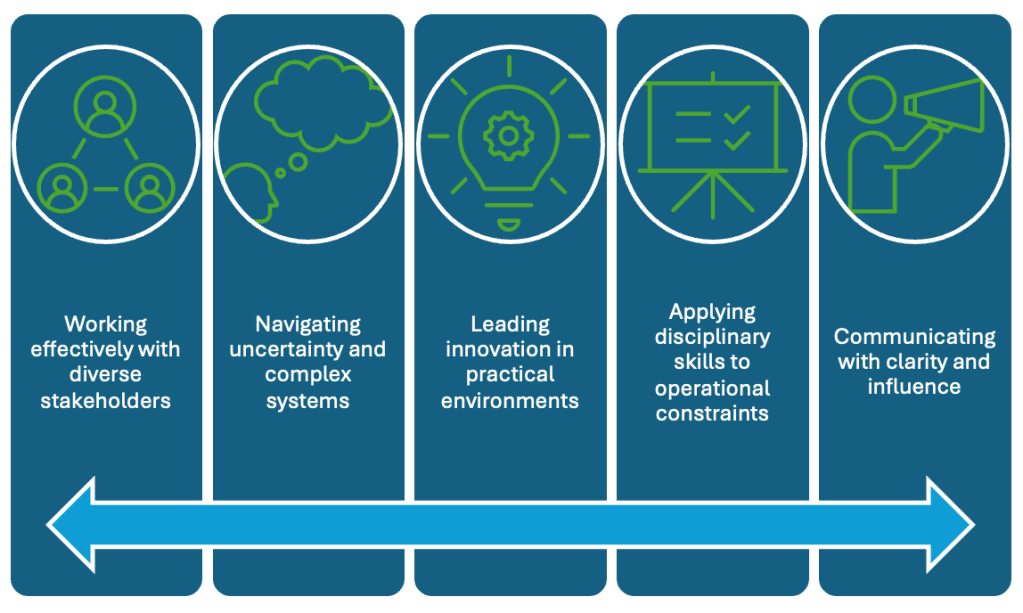
However, they also highlighted skills they felt were missing in researchers. While they valued postdoctoral researchers for their technical expertise and analytical rigour, they noted gaps in practical application, interdisciplinary collaboration, strategic communication, and leadership. As one participant put it, many researchers excel at identifying problems but lack the commercial or policy understanding needed to solve them effectively within organisational constraints.
The issue is unlikely to be that researchers lack these skills altogether. Rather, it reflects a mix of challenges: translating research skills into industrial contexts, identifying the sector-specific vocabulary to articulate these skills, and a lack of training or mentoring for communicating confidently outside academia.
Designing the C-DICE Net Zero Skills Framework
To bridge the gap between researcher experience and industry expectations, C-DICE worked with Elizabeth Adams of Scafell Coaching to gather deeper insights from postdocs and researcher developers, and to review existing sector frameworks, including the Vitae Researcher Development Framework and REF impact guidance. While valuable, the existing frameworks offer limited support for cross-sector mobility or net zero pathways.
So, we developed something that could:
- Act as a navigation tool,
- Give researchers language to describe skills,
- Support supervisors and institutions to have meaningful development conversations,
- Make career development proactive rather than reactive.
Drawing on findings published in Cleaner Engineering and Technology, the resulting framework places technical expertise at the core, surrounded by three interconnected domains: Leadership and Influence, Research and Innovation Capability, Collaboration and Partnerships.
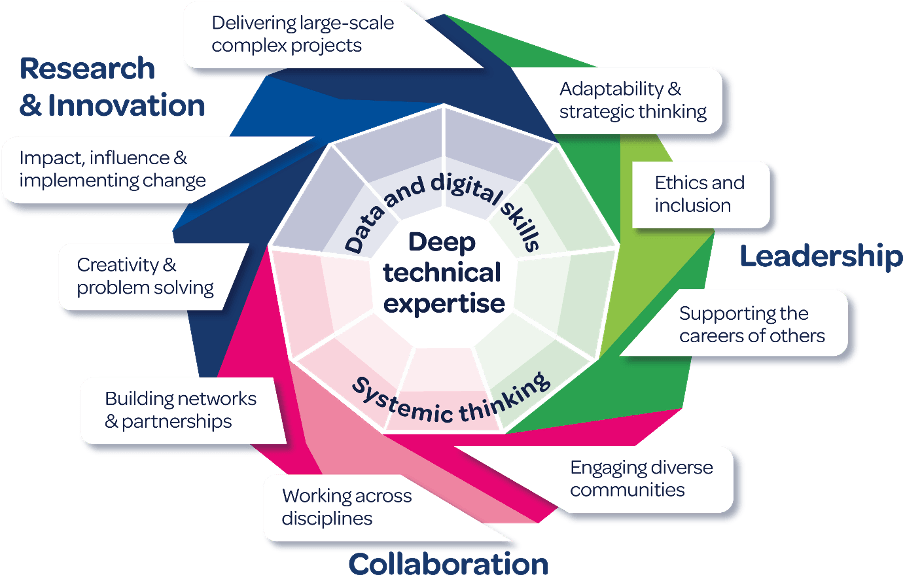
Digital literacy and systems thinking are embedded throughout the framework, recognising that net-zero work demands the capacity to navigate complex, interconnected systems and to drive transformative change.
To bring the framework to life, we created three personas representing example researcher journeys:
- Elena – A social scientist applying systems thinking to industry sustainability challenges.
- Tom – An engineer transitioning toward cross-sector innovation leadership,
- Aisha – A materials scientist exploring policy and consulting.

These personas serve as realistic, relatable examples of how skills evolve and how career paths can widen beyond traditional expectations.
How researchers engage with the framework
Here’s where it gets practical. The turning point for many researchers comes when they use the framework to reflect on real experiences:
- A secondment suddenly becomes evidence of adaptability, influence, or cross-sector partnership.
- A cross-disciplinary collaboration becomes proof of systems thinking or innovation leadership.
- A workshop or public engagement activity becomes an example of communication with impact.
C-DICE introduced the framework through a workshop with postdoctoral researchers. Using the three personas as examples, participants worked through the framework to identify their own skill gaps, recognise existing strengths, set development priorities, and practice articulating their capabilities for CVs and job applications. The framework helps researchers think strategically about development opportunities such as networking grants, secondments, and professional development programmes offered through C-DICE and other initiatives.
Many commented that it helped them “see” skills they had never recognised as valuable. This is a powerful shift when planning a career, especially when considering pathways beyond academia.
Beyond C-DICE, the framework aligns with wider sector development initiatives, including those offered by bodies such as the British Academy, highlighting its relevance across disciplines and career stages.
From aspiration to action: Supporting whole-ecosystem development
Researcher development is a shared responsibility across institutions, funders, supervisors, and research teams. This principle is firmly embedded in the Concordat to Support the Career Development of Researchers (2019).
What has been missing is a practical mechanism that helps different parts of the ecosystem have the same conversation.
The C-DICE Net Zero Skills Framework fills this gap. It can support:
- Researchers, to plan strategically and confidently,
- Supervisors, to guide development discussions,
- Researcher developers, to design programmes addressing skill needs,
- Institutions, to create environments aligned with sector expectations.
By making skills visible and transferable, it also helps reduce some of the vulnerabilities associated with narrow career pathways and supports more equitable access to opportunity.
An invitation to the REDS community
As the research sector adapts to global challenges, we need tools that help researchers navigate complexity, build confidence, and pursue careers that create meaningful impact. The C-DICE Net Zero Skills Framework offers one way to do this: a structured, accessible guide that helps researchers articulate their capabilities, explore diverse career routes, and contribute directly to society’s net-zero ambitions.
We invite you, colleagues across the REDS community, to explore, adapt, and use the framework. Try it with your researchers, use it in coaching conversations and PDRs, and embed it in development programmes. Then share back what you learn, so we can collectively strengthen cultures of development. Because when researchers thrive, so does our capacity for innovation, resilience, and the creativity needed to tackle the most significant global challenges.
 Researcher Education and Development Scholarship Conference
Leave a comment