By Raescla Ribeiro de Oliveira, Doctoral Researcher, Federal University of Amazonas (UFAM), Brasil, and Professor Iolete Ribeiro da Silva, Director of the Faculty of Psychology, Federal University of Amazonas (UFAM), Brasil.
To create more inclusion and to change how international education works, the Brazilian government started the Abdias Nascimento Academic Program (2024–2028). The goal of this program is to support the international studies of Black and Indigenous graduate students, as well as people with disabilities, high abilities, or developmental disorders.
This project questions the idea that only white men belong in academic and scientific spaces. According to Matos et al. (2016) in Brazil many people still imagine a scientist as a white, upper-class man. The history, society, and culture that gave power to white men and whiteness have, through colonialism, excluded many other groups of people. This way of thinking comes from the old colonial system. However, the science we want to build today should be open, diverse, and inclusive. It should respect different cultures, experiences, and ways of understanding the world.
To reach this goal, we need creativity to guide new ideas for the academic world. By sharing information about this program, we want to show how creative and decolonial actions, supported by funding and international projects, can help reduce inequality and break barriers that still exist in education and Science. As Black women in science, we see this program as an important action to reduce inequality and create more inclusive and representative spaces for producing knowledge.
This text presents the Brazilian government’s initiative from our different points of view. The first author is a PhD student in the program and joined the first mission to the United Kingdom in 2025. The second author is the program coordinator at the Federal University of Amazonas (UFAM).
Together, we as authors share our experiences, to show the potential and importance of this program.
The role of the Abdias Nascimento Scholarship in addressing gender and racial inequalities
The program at UFAM focuses on three main areas. First, it works to increase the participation of Black women in research. Second, it aims to include the Amazon region in international projects and opportunities. Third, it seeks to improve English skills in Brazil. To better understand this situation, we will look briefly at some data and numbers.
In Brazil, Black people make up the largest part of the population, 55.4%, according to IBGE (2022). However, in research groups, this number is not proportional. Charini et al. (2024, p. 104) studied the number of leaders by gender and race in Brazilian research groups. They found that “Black women leaders of research groups are underrepresented.”. The study also shows differences between regions of Brazil. For example, in the Southeast region in 2023, white men represented 34.5%, white women 35.5%, Black men 8.1%, and Black women only 7.0%. In 2000, the numbers were even lower: Black men were 2.8% and Black women 1.7%.
In another study, Charini, Rapini, and Santos (2024) show that in the Directory of Research Groups (DGP) from 2000 to 2023, the Southeast region had the largest number of registered institutions, about 40% in 2023, while the North region had only 10%.
Concerning English language knowledge in Brazil, a British Council report (2014) says that only 5.1% of the population claims to know some English. When we compare this with studies that show the historical and social exclusion of Black people, especially Black women, we can clearly see why programs like this are necessary.
‘Dabacuri’ and ‘Aquilombamento’: possible sharings between the Amazon and the UK
UFAM, a university located in the Amazon region, received the Abdias Nascimento Program with the project “Dabacuri and Aquilombamento: Building Affirmative Action Policies in Amazonian Graduate Studies.”
During the project, a partnership was created with the Academy Community Training & Research Institute (MaCTRI), an organisation in Manchester, led by Professor Ornette Clennon, the Head of the Institute. MaCTRI helped by providing workspace, mentoring activities, and by organising an event called Summer School 2025 to share the students’ research. With its strong experience in decolonial studies, MaCTRI played an important role in creating a supportive environment that helped the grant students grow and work more independently as young researchers.
This made it possible to apply two main ideas of the project: ‘Dabacuri’ and ‘Aquilombamento’. These concepts come from Indigenous and African ancestral knowledge and help build cultural identity.
Dabacuri is an old Indigenous ritual from the Alto Rio Negro region that celebrates abundance and unity among different peoples. During this ceremony, people share knowledge and skills through songs, music, dances, drinks, food, stories, and traditional ornaments. It is also a time for social and political alliances and marriage arrangements.
The people making the offering visit another village bringing fish, fruits, or handmade products. The hosts welcome them with caxiri, a drink made from fermented cassava. Later, the hosts return the offering, showing reciprocity and friendship between the groups.
Aquilombamento means joining together in resistance, especially within the Black community, to fight against oppression. To aquilombar is to become part of a collective struggle, sharing care, solidarity, and identity.
Based on these two ideas, the project uses ancestral creativity to fight against epistemic racism, which is the exclusion of Black, Indigenous, Latin American, and critical knowledge from academic and research spaces.
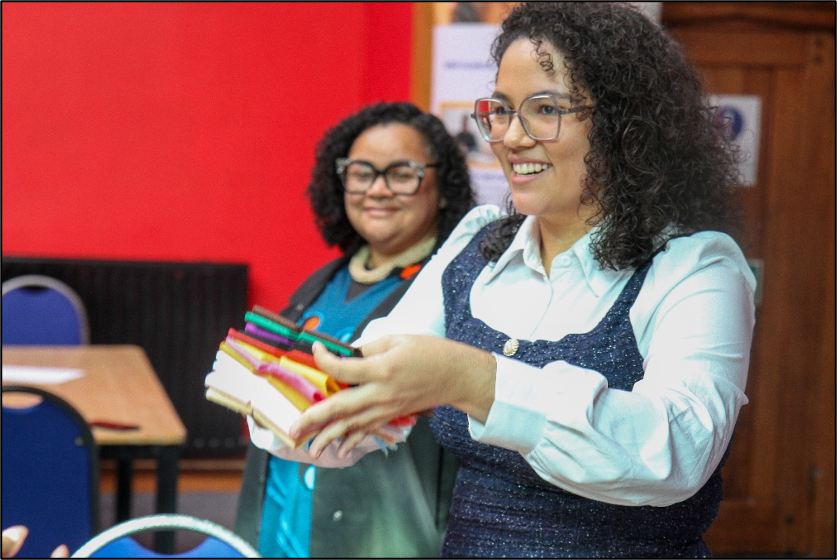
During the 2025 UFAM-MaCTRI Summer School, we introduced Abayomi dolls, created by Brazilian artisan Lena Martins as representative toys for Black children. Applying Dabacuri and Aquilombamento, we shared the dolls’ history and materials, inviting them to make their own. This fostered connection, cultural exchange, and new perspectives on collaborative academia.
Concluding remarks
From our experience, we understand this project as a significant example of how collaboration can reduce inequality in universities, creating new spaces and opportunities that were once distant or inaccessible to Black women, especially those from the Amazon region.
What we need are opportunities to use our creativity in building a collective and collaborative science that does not see us as just objects, but instead values our voices, ideas, and contributions.
 Researcher Education and Development Scholarship Conference
Leave a comment