By Dr Nicola Palmer, Head of Doctoral Training at Sheffield Hallam University, UK and Senior Lecturer at University of York, UK (ORCiD) and Dr Richard Tresidder, Associate Professor at Sheffield Hallam University, UK (ORCiD).
In many institutions, supervisor development is led by dedicated ‘third space professionals’ (Whitchurch, 2022) who can offer invaluable expertise in pedagogy, researcher development, and institutional policy. But, in the complex world of doctoral education amidst higher education resource pressures, sometimes supervisor development falls to academics like us – active research supervisors with doctoral leadership roles, burgeoning pedagogical expertise, and networked links across multiple doctoral communities of practice.
We’ve found that research supervisors value tacit, experience-based knowledge, the kind of wisdom gained only through years of practice. A specific credibility comes from authentic understanding as noted by Halse (2011), Whitchurch (2012) and Huet and Casanova (2022). When a supervisor developer understands those visceral pressures of a looming thesis submission deadline, the delicacy of fractured student-supervisor and/or supervisor-supervisor relationships and, even, the discomfort of being harassed or stalked by a doctoral candidate, reflective practice can be supported more effectively, and the training dynamic can shift to a shared professional consultation. We’ve come to realise that there’s often an overlooked or underplayed dimension of many supervisor development programmes: the power of the peer context.
Catalysing peer-to-peer dialogic supervisor development
We wanted to design a tool that allows any developer – be they an academic or a professional service lead – to tap into the supervisor’s voice. For us, this became increasingly important because of our involvement as consortium partners in the Next Generation Research SuperVision Project (RSVP) whereby we have been actively involved in co-creating and sharing supervisor-focused continuing professional development (CPD) resources between institutions with differing supervisor development delivery structures. This encouraged us to reflect on our pedagogy as supervisor developers.
By positioning ourselves as co-learners rather than experts delivering content to passive recipients, there’s an opportunity to reduce power differentials (Guccione and Bonner-Evans, 2025) and create a dialogic space where supervisors feel safe and secure to reflect on their own vulnerabilities and successes. This can transform potential resistance to supervisor-focused CPD into deep engagement. Drawing on the work of Skidmore and Murakami (2018), we recognised that dialogue between supervisors across disciplines and types of doctorate doesn’t always happen spontaneously. It often requires a catalyst. This led us to develop a set of reflective cue cards that can be used by supervisor developers to prompt meaningful, relevant and authentic discussions.
Cue cards are recognised to facilitate knowledge sharing and drive peer-to-peer, dialogic learner development. They can be used as structured, flexible prompts to encourage critical self-examination and progress the evolution of supervisory practice (Kiley, 2017) in line with a reflective CPD culture.
Harnessing supervisor voice to develop a culture of reflective supervisor development
Our cue cards were developed and refined through four cohorts of an institution-wide Intermediate Supervisor Development Award (ISDA) aimed at academics with lived experiences of supervising doctoral candidates, across disciplines and types of doctoral award. ISDA consists of a series of three on-campus sessions delivered twice a year, mapped to combined overlapping dimensions of the UKCGE | Good Supervisory Practice Framework as well as the original Vitae Researcher Development Framework, our institutional personal development review and academic careers framework. Through ISDA we intentionally created conversational peer-to-peer discussion space to support thematic open reflection on supervision practice. In doing so, we responded to feedback from supervisors who had completed our institutional new supervisor course as well as findings from the UKCGE | UK Research Supervision Survey 2021 Report that collectively highlighted supervisors’ desire for peer learning to support their professional development and reflective practice. Each ISDA session supports structured reflection and incremental building of a portfolio of evidence to assist development of associate and full applications for UKCGE research supervision recognition .
Based on peer-to-peer discussions on supervisory practice across four ISDA cohorts, to date, we have developed sixty-four cue cards across seven emergent themes: training and readiness; workload and well-being; collaborative relationships; supporting diversity and inclusion; research ethics and integrity; student well-being and pastoral support; and institutional support and recognition. Each card presents a question or provocation, grounded in supervisor lived experiences, that can be used support authentic understanding of supervision. Examples include:
- How can excellent supervision be provided within the workload time allocation given to supervision at your university?
- Do you feel confident in your ability to mentor candidates from diverse backgrounds?
- How do you manage conflicting expectations from co-supervisors?
- Have you ever felt excluded from a supervisory package?
- How do you support candidates facing family or personal issues?
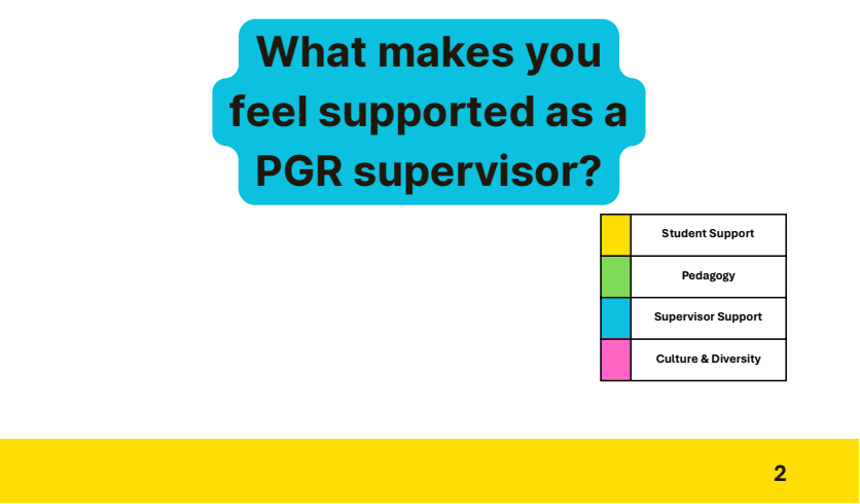
- What makes you feel supported as a PGR supervisor?
The cards acknowledge salient real-life structural and personal challenges of contemporary research supervision and provide us with an evidence-informed, relationally grounded tool to foreground supervisor voice across supervisor development activities. They facilitate richer reflective learning and strengthen links between disciplinary, pedagogical, and institutional aspects without requiring intensive delivery resources.
As supervisor developers, we are no longer delivering or facilitating a course or programme; we are actively participating in a culture of constant self-reflection on supervision practice – continuous reflective professional development. We are fostering a peer learning culture that allows us, as academic supervisors, to be an integral part.
Potential value
For third space professionals leading supervisor development, we can see potential value in our cue cards as a tool to support shifting of the academic-professional power differential. Our cue cards can be embedded within supervisor development programmes or form the basis of ad hoc standalone development sessions in flexible delivery formats (university-wide or at local levels, online or on campus). Our cue card intervention offers a scalable, evidence-based model to enhance supervisory capacity and can contribute to fostering and sustaining a high-impact, reflective development culture institution-wide and beyond.
We introduced a prototype version of our cue cards to an audience of international academic supervisors, doctoral programme leaders and academic and third space supervisor developers at the 2025 EFMD Doctoral Programmes Conference hosted by Manchester Metropolitan University, UK and received positive feedback.
If you are a supervisor developer interested in our reflective cue cards please get in touch with us: n.palmer@shu.ac.uk or richard.tresidder@shu.ac.uk
 Researcher Education and Development Scholarship Conference
Leave a comment