By Jennifer McNally, Researcher Developer and Part-time Doctoral Researcher in Global Education, Coventry University, UK.

Pursuing a doctoral level degree is often framed as a deeply enriching personal and intellectual journey, yet, in reality, many doctoral researchers encounter significant challenges and stressors that demand robust, meaningful support. Studies indicate that doctoral researchers face disproportionately higher levels of mental health challenges than the general population, with international doctoral researchers particularly at risk due to an increased likelihood of attrition and well-being concerns (Metcalfe, Wilson and Levecque, 2018, Hazell et al. 2021).
This blog post will share insights from my PhD project which explores how a creative and participatory visual research method, called Photovoice, has been used to capture international doctoral researcher’s lived experiences and wellbeing challenges during their transition onto a UK doctoral research programme. This project questions whether early intervention is a crucial step in supporting doctoral researcher mental health and wellbeing during this transitional time (Jackman et al. 2022). Here, I will share how Photovoice can serve as a creative and insightful tool to bring community together and foreground researcher voice and experience.
Back in 2020, I started a PhD project of my own
This research is shaped by my dual positionality as both a researcher developer within a UK university and as a doctoral researcher working towards a PhD in global education. Beginning my PhD in 2020 prompted me to critically reflect on how researcher developers, and wider institutional support services, can better serve international doctoral researchers as they navigate the complex transition into doctoral study.
For many researchers conducting qualitative research within higher education (HE), interviews are the research method of choice. The value of using alternative research methods, such as visual methodologies, to provide a different perspective is being recognised within other fields outside of HE therefore, I decided that my research project would provide an alternative dialogue to the conversations around researcher wellbeing (Adeboye et al., 2025, Wass et al., 2020). After a thorough investigation, and some soul searching, I fell in love with the research method Photovoice. It was a fantastic tool to help me achieve my project aims, offering the potential to inject creativity into the project, as well as enabling the active engagement of the research participants within the research process.
Fast forward 5 years, one global pandemic, an ever-somersaulting HE sector and two maternity leaves, I am now finally approaching the concluding epoch of my PhD project. So, does Photovoice offer a creative approach which provides researcher developers with an opportunity to innovate, while fostering creativity and resilience within the research community we serve?
The power to empower
Photovoice is a visual participatory research method that empowers research participants to use photography and discussion to document, reflect and communicate their lived experience, often as a catalyst for improved understanding and social change (Wang and Burris, 1997). In HE, Photovoice has been utilised to gain deeper, student-centered insights into student experience, strengths and challenges around topics such as mental health challenges, belonging and campus spaces (Wass et al., 2020, Girang et al., 2022, Cornell, Kessi, and Ratele, 2022). Within the literature, the use of Photovoice to explore the wellbeing experiences of doctoral researchers is limited and, arguably, Photovoice remains an underused tool within the researcher development space.
Within my PhD research, Photovoice was used to explore the experience of international doctoral researcher by encouraging participants to visually represent their wellbeing through photographs, capturing aspects of their day-to-day life. All participants identified as international doctoral researchers and were within the first 12 months of their doctoral programme. Participants were then invited to share their photographs and take part in a focus group, engaging in critical dialogue about their wellbeing and the factors influencing their transition into doctoral study.
Below I have included some of the emotive images that international doctoral researchers decided to share within this study. I have also highlighted four key insights that I have gained from facilitating the Photovoice project as a doctoral researcher myself, and as a researcher developer.
Key benefits of using photovoice in Higher Educational research

Research Participant 2 (Picture This: PhD Research Project): The transformative nature of Photovoice means that participants are no longer research subjects but active co-creators. Photovoice encourages participants to go out into their own world and answer question prompts through their photography. Research participants choose what story they want to tell through the photographs they select and share in a focus group. Many researchers appreciate the participatory nature of the research method which helps to improve researcher – research participant relationship building, as well as provide the opportunity to empower research participants (Torre and Murphy, 2015).

Research Participant 5 (Picture This: PhD Research Project): Visual research methods have the potential to showcase a different frame of reference. Despite non-visual research methods remaining more common, photo-elicitation methods reveal the lived experience of the research participants from a unique, visual perspective, offering an alternative approach to knowledge generation (Wass et al., 2020). It can also be argued that data generated within a Photovoice study has the potential to be richer than words-alone interview data due to the opportunities for personal reflection and critical dialogue that the Photovoice process provides (Milne and Muir, 2020).

Research Participant 9 (Picture This: PhD Research Project): Discussing personal, mental health or wellbeing challenges can be hard. Through the opportunity to self-reflect, document through photography and share with a group of peers, it is hoped that these often-stigmatised topics are easier to discuss, compared to words-alone methods, such as within an interview context. In addition, the opportunity to engage with peers who share similar experiences can provide therapeutic benefits by reducing feelings of isolation and normalising aspects of participants’ experiences and even boosting a person’s sense of belonging (Milasan, 2024).
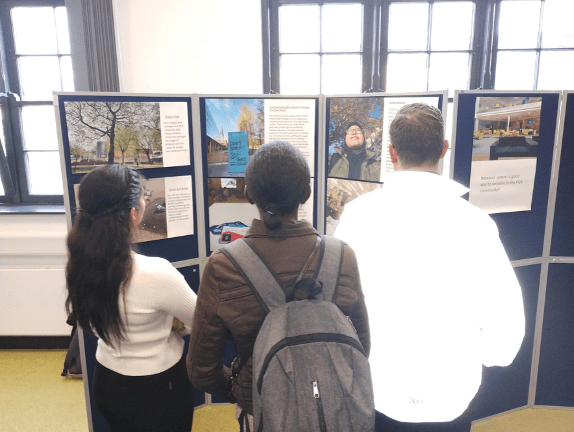
Photovoice Exhibition, Coventry University (Picture This: PhD Research Project): One of the most significant benefits of using the Photovoice research method is the opportunity to showcase research participant photography in an exhibition setting, delivering a powerful and emotive message that makes complex issues like well-being tangible and relatable. This phase is crucial because it has the potential to influence key stakeholders, spark dialogue and possibly inform policy (Latz, 2017). In the context of this project, the exhibition also provides a platform to challenge the stigma around mental health and wellbeing in HE, where low disclosure rates in UK Universities suggest fears of reputational harm and a lack of inclusivity (Equality Challenge Unit, 2014). By sharing real life stories, Photovoice can be used to validate experience and confront stigma (Milasan, 2024). By highlighting the richness and complexity of the international doctoral researcher journey, we are offering audiences a nuanced understanding of important topics such as academic and cultural transition, belonging, identity and wellbeing.
What have I learnt?
Emotive Reactions:Within my study, photographs served as a prompt to generate further discussion within the focus group environment. Photographs were a fantastic way for individuals to represent and communicate an experience that would inspire an emotive reaction from the wider group. This emotive environment continued within the exhibition where attendees embraced the lived experiences shared by the research participants.
Generating a Community of Support: What makes this approach particularly powerful is the community it cultivates throughout the research process. Although data analysis is still in its early stages, initial findings suggest that creating spaces where doctoral researchers can regularly share their challenges, reflections, and successes is not merely advantageous—it is essential, and too often underestimated (Milasan, 2024). Looking ahead to 2026, the Researcher Development Team at Coventry University’s Doctoral and Researcher College will be facilitating a Photovoice project designed tostrengthen community-building among postgraduate researchers. Through shared discussions about community, identity, and wellbeing, participants will collaboratively explore and express their experiences. The project will culminate in an exhibition at our annual Researcher Capability and Development Conference in Summer 2026, showcasing the voices and perspectives of our postgraduate researcher community. By harnessing Photovoice’s capacity to evoke an emotional response, foster feelings of belonging, and shine a light on the complex experiences of postgraduate researchers, this approach has the potential to enhance postgraduate researcher wellbeing and in doing so contribute positively to retention and research degree outcomes.
 Researcher Education and Development Scholarship Conference
Leave a comment