By Professor Jennifer Smith Maguire, Associate Dean for Research, Innovation and Knowledge Exchange, College of Business, Technology and Engineering, Sheffield Hallam University
The script below is based on Jennifer’s keynote address – The Radical Power of Fun: Playfulness as a Catalyst for Research Culture Development – at the 2026 REDS Conference ‘Getting creative: Shaping a culture of development’.
Jennifer Smith Maguire CC BY-NC 4.0
Thank you for the invitation to drop an F-bomb into your conference today!! That F-bomb, of course, is fun.
My focus is on the radical power of fun as a catalyst for developing research cultures that are impact-oriented, inclusive and inspiring. I’ll be drawing on my experiences as Associate Dean for Research, Innovation and Knowledge Exchange—otherwise known as RIKE—at Sheffield Hallam University, but also my sociological interest in forms of leisure and play.
The first thing I should say is that building fun into researcher development can feel really risky, both for those taking part, and for those organising and leading the activities.
For those taking part: Fun can sit uneasily alongside academic authority, unsettling serious performances of specialist expertise. We know that academic authority is not worn lightly by many academics. ‘Having fun’ or ‘being fun’ can be perceived as frivolous, undermining precarious credibility and status in the face of imposter syndrome, and systemic barriers to inclusion.
For those organising and leading development activities:
Fun can feel risky because so much rests on the participants buying in, letting go, and collaboratively accomplishing the fun. As such, when you foreground fun, there’s a threat that it will fall flat or blow up in your face. That’s asking a lot of research developers’ sense of confidence, their resilience, their openness to risk.
Fun can also feel risky in that it jars against the highly pressured higher education sector context in which we find ourselves.
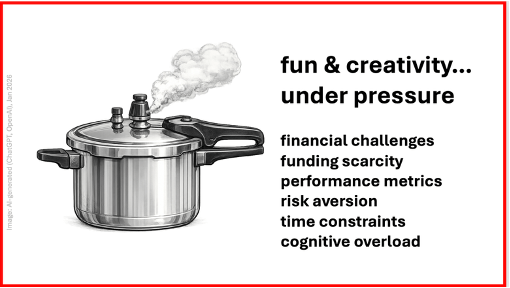
Indeed, the prospects for fun and creativity can feel pretty grim against the backdrop of our sector-wide dumpster fire: financial pressures, funding scarcity, performance metrics, audit and accountability regimes, time constraints and cognitive overload.
I won’t rehearse these challenges in any detail – you will all know them intimately, albeit in differing degrees and intensities. The important point is that they are not individual problems; they are systemic issues and, by now, sustained conditions that place individuals and institutions under mounting pressure.
So, fun feels risky: it might be a way to let off a little steam, but it might also blow the whole lid off, and make a mess of the kitchen!
It’s that potential to disorder things, to undermine authority, to run against the dominant narrative of performance and productivity, that gives fun its radical potential. All of which is to say: fun is not frivolous.
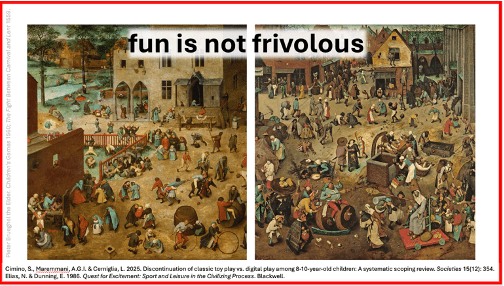
Fun is deeply, fundamentally embedded as a feature of human culture, as is so wonderfully captured in these two mid-16th century scenes by Dutch painter Pieter Breughel The Elder.
On the one hand, on the left of the slide: we have the play of children. Through their imaginative worlds and spontaneous, unstructured games, children acquire opportunities for learning, creativity, social interaction, and emotional exploration. And although it may feel to the adult trying to take part in children’s games that they are without rules, they are anything but, thereby play affords children developmental benefits around self-regulation.
However, research makes clear that these benefits of open-ended play are under threat. The shift to more screen time, and thus more structured and scripted play, brings developmental concerns and worrying socio-emotional risks. (If you’re interested, see Cimino et al (2025) for a useful meta-analysis of the research on this issue.)
On the other hand, as we move into the adult world, play tends to shift from mimetic, non-instrumental, spontaneous activities to more planned, rational, and ends-driven pursuits. Nevertheless, there persist in the adult world a number of vestiges in which the play element hangs on. One such instance is the carnival, captured by Breughel on the right side of the slide. The figures in the painting’s foreground are emblematic of the carnival dynamic in which the vibrant chaos of quotidian life temporarily unseats the normative dominance of propriety and power. Here, the King of the Carnival, a dishevelled, robust figure in red tights and a blue shirt, sits astride a barrel, balancing a pie on his head. Opposite, a feeble robed figure, representing Lent. The fragile Friar Lent holds a paddle with two meagre fish, which are no match in the joust with the Carnival King’s spit furnished with multiple cuts of meat.
This revelry is what Sociologists Elias and Dunning (1986: 124-5) refer to as the ‘controlled decontrolling of emotions’. Carnival is one of those critical moments in social life in which the social order is temporarily allowed to be inverted. This can function as a steam valve on the pressure cooker, a momentary loosening of the emotional armour of everyday life.
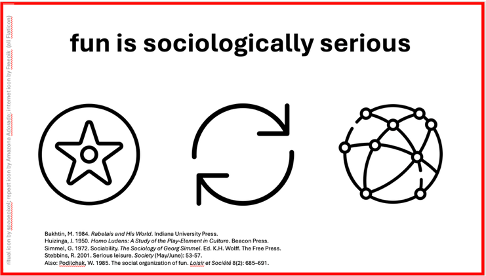
There is a substantial body of social sciences and humanities scholarship that attempts to unpack the seriousness of play, making the case for how fundamental it is for human flourishing, and critically highlighting the implications for us as individuals, communities and societies, when that play element is eroded and put under pressure.
I want to highlight three key themes from that literature, to serve as potential tools for research development toolboxes. (For an accessible overview: Walter Podilchak (1985) provides a nice summary of the preconditions and consequences of fun.)
First, there is the question of where and when play can thrive. Here, we can turn to Johan Huizinga (1950), whose work on the play element in human culture underscores the importance of the play-ground, within which play takes place. The playground is marked off physically and symbolically, either via deliberate action, or via custom and convention. We might think of the boxing ring, the theatrical stage or the magic circle: bounded spaces, temporary worlds, and hallowed grounds, both real and virtual, in which the normal order is suspended.
For this theme, I suggest an icon of a circle containing a star: the perimeter clearing demarking a playground within which special rules apply, however temporarily.
Second, there is the question of what play does. My suggested icon of two arrows caught in mid swirl reflects the principle that play enables a loosening, flux or inversion of, or even a resistance to, the normal order of things. Fun isn’t merely amusement; it makes possible the temporary suspension of social hierarchies and norms. Here, our point of reference is Mikhail Bakhtin (1984), whose work on carnival and the grotesque highlights the dynamic captured by the Carnival King and Friar Lent. Carnival doesn’t destroy the social order; rather it turns it upside down, such that imperfections are valued above polished performances, and those at the margins find themselves flipped onto centre stage. While the inversion is temporary, there is the possibility that it lasts long enough for people to see things differently and perhaps effect long-lasting change thereafter.
This leads us to the third theme: what are the durable implicationsof play? Here, we turn to Georg Simmel (1972), who underlined that play, pleasure and friendliness are essential elements of human sociability and crucial for the formation of meaningful social bonds. These affective attachments, sprouted in playful soil and fertilized through shared interaction, can endure beyond the moment of play, shaping solidarities, commitments, and capacities for collective work. My suggested icon is the networked sphere.
In critical readings of modernity, we see the long-term degradation of play, as spontaneous, open-ended activity is crowded out by a proliferation of mindless distractions and overly instrumental forms of leisure. As a result, those social bonds and affective attachments can weaken, and the individual—that spark at each node in my networked sphere—bears the corrosive consequences. Sociologist of leisure Robert Stebbins describes this as a sort of psychological dyspepsia: ‘a sense of ennui and listlessness rooted in the unsettling realisation that one’s life is unfolding in a way largely, if not entirely, devoid of any significant excitement’ (2001: 53).
Taken together, this literature highlights the importance of creating bounded spaces in which play can thrive, recognising play’s capacity to temporarily loosen and invert the normal order, and attending to the durable social bonds and commitments that playful interaction can generate over time.
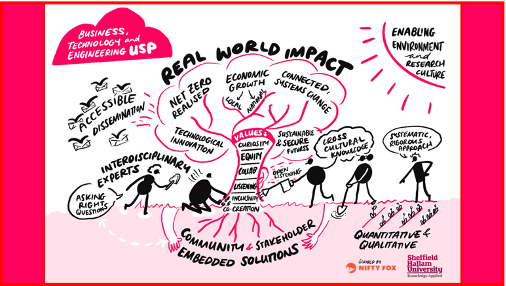
bring these theoretical observations to life, let me now turn to my specific context of researcher development, in an interdisciplinary college spanning schools of engineering, computing, and business and management, at Sheffield Hallam University.
Over the last two and a half years, our over-arching aim with the College has been to develop an impact-oriented, inclusive, and inspiring research culture. These attributes invoke certain pre-conditions and invite certain consequences:
- To be impact-oriented, we need to erode barriers between research, innovation and knowledge exchange, and encourage a more porous relationship between the insides and outsides of universities;
- To be inclusive, we must break down barriers between disciplines through more effective science communication, and break down barriers between people by flattening hierarchies;
- And in being inspiring, we might help restore higher education as a domain of ‘good work’ that is meaningful for both individual biographies and societal sustainability.
In pursuit of this aim, we have designed and delivered a series of five full-day researcher development events, targeting a diverse population—both reflecting our multi-disciplinary composition, and the university’s RIKE journey, which saw us double the number of submitted staff from REF2014 to REF2021.
As an example: the image on the slide is the outcome of our July 2025 event, for which Laura Evans-Hill from Nifty Fox Creative live scribed our afternoon session to help us identify our multi-disciplinary USP, or unique selling point.
More generally, the events focused on foundational skills for an impact-oriented, inclusive, and inspiring research culture, such as:
- skills for building genuinely interdisciplinary teams;
- embedding a theory of change approach to support impactful research;
- skills for working with user communities, such as active listening and collaboration;
- effective science communication and visual communication skills;
- role models of sustainable RIKE careers.
Let me now share four sets of examples of what works (and what doesn’t) when fun is built into researcher development.
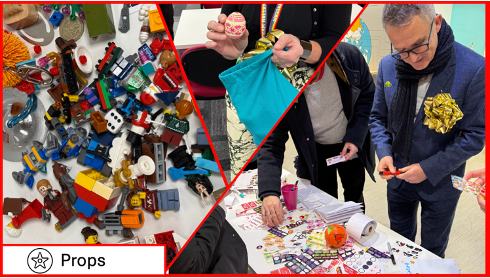
First, it’s all about the props. This returns us to the need to clearly mark out the playground physically and symbolically. Lego figures, coins, dice, pipe cleaners and play dough all signal that participants are entering the play zone. (It’s also a great way to upcycle the Christmas cracker tat and general detritus from your kids!)
We use props to help upend the normal order of things. For example, the middle image of the painted egg: we’ve used these as ‘talking sticks’ to grant the holder exclusive speaking rights. This can be really useful for ensuring seldom heard voices are given their turn and not interrupted or ignored.
We’re also very committed to the make-your-own name tag table, with loads of pens and silly stickers. These name tags do a number of things. By letting people choose what they’re called, and role modelling that a name tag needs a first name, no title, the name tags help to flatten the institutional hierarchies and emphasise interpersonal connection over organisational pecking order. Additionally, as per ‘Open Space Technology’, the emphasis is on those present being the right people: there is no table of unclaimed nametags for those who didn’t turn up.
Name tags and stickers are also a good example of where things can go wrong. You can’t force someone to play along. They may write their title as a matter of habit; they may avoid the stickers for fear of appearing childish. Even Jayne, my professional services colleague who was charged with sourcing the stickers for the most recent event, found stickers anxiety-inducing—she was worried that she’d bought the wrong ones because they were intended for children. But the wonderful thing about these name tags is that they’re adjustable; you can go back later, add more stickers, once trust in the process builds up.
The last prop I want to mention is that glorious large gold rosette that my colleague at the name tag table is sporting, which takes me forward to those who wear them: the facilitators.
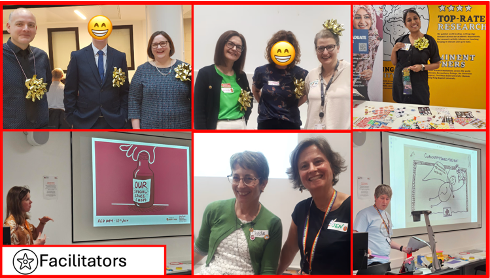
Second: researcher development is very much a team sport. Each event involves a team of facilitators. Events can be quite hectic, carnival-like events, so it’s important to have an immediately obvious way to mark out the facilitators for participants. Et voilà: the gold rosette! Not only do they clearly signal who are the facilitators, but they also reinforce the symbolic marking of the play-ground. Where else would you wear such a bow?
Facilitators don’t just guide the action, they are also crucial for building trust and credibility, to help participants get over their fears, anxiety and uneasiness with fun. It’s been important that our facilitators are drawn from across our academic teams—from profs to ECRs—and our Research and Innovation Service colleagues, to reinforce the message of a collaborative, whole-university effort.
This doesn’t always work: we’ve had some facilitators who couldn’t fully shake their own discomfort with fun. But equally, we’ve had key academic participants who really buy in, helping to spread trust in the process within other participants – a great example in the bottom right there, with Chris Sammon, our head of RIKE for engineering who is always game.
We’ve also made really smart investments in external facilitators and collaborators. That’s Laura Evans-Hill of Nifty Fox Creative on the lower left, who live scribed the College USP image I showed you earlier. In the middle there with me is Christine Bell, from the Centre of Facilitation. Both Christine and Laura have helped build credibility among our participants by lending their bona fides—the universities and funders they’ve worked with. Indeed, most of the good ideas that I’m sharing in this presentation are directly attributable to Christine—with the exception of the gold rosettes, which I’m tickled pink Christine has now borrowed from us!
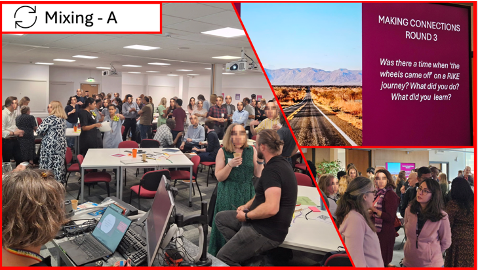
Third, in terms of inversion, we have a key warm up activity from Christine called ‘making connections.’ This involves participants forming pairs for brief, impromptu conversations. Over three rounds, we ask participants to spontaneously create a pair with someone they’ve not yet met. They’re then asked to introduce themselves with no more than one breath – that tends to curtail long-winded titles and disciplinary position statements. They then respond to a conversation starter that establishes common ground and ideally flattens any advantage that might come from seniority or other structural advantages. For example, from last week: for one round we asked participants to share an example of when the ‘wheels came off’ on their RIKE journey; from another event, we asked people what they had in common with a picture of a tree. The focus here is on non-instrumental interaction—literally, just making a connection—with cues to signal that the normal organisational hierarchies do not apply.
The downside to such activities is that, in keeping with carnival, they tend to be loud and somewhat chaotic. That’s not the most inclusive and accessible environment for some people, so we’ve developed a ‘quieter option’ route, but take up hasn’t been great so we haven’t yet got that balance quite right.
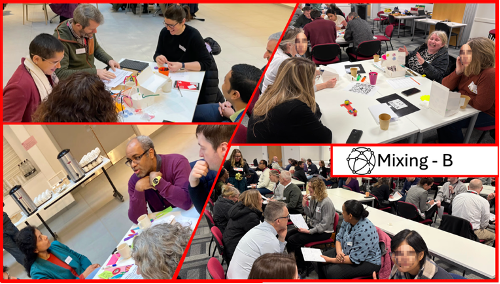
Fourth: the making connections warm up activity helps to lay the groundwork for the rest of the day.
As the event proceeds, we move to more structured, mixed cross-College groups focused on tangible outcomes, such as workshopping visual models or speed pitching, as in these photos. Providing groups with a collective purpose or task to fulfil shifts the balance away from the spontaneity of the earlier activities. But this progression is important; without it, we’ve found that the fun can start to feel frivolous, and engagement starts to flag. People need a clear sense of purpose that the event is a good investment of their precious time.
Nevertheless, there are still elements of fun such as activities using coloured paper, pipe cleaners, and playdough. Because the materials aren’t strictly serious, experimentation is encouraged and we tend to see a lot of laughter—as these photos nicely reflect. But importantly, working in small groups affords opportunities for social interaction, creating the potential for genuine, durable bonds that extend beyond the day itself.
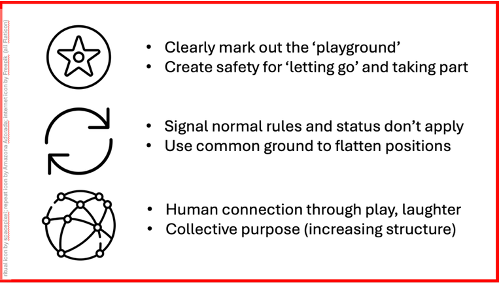
Hopefully, you can see how some of these attributes of play have characterised the events, spotted a few ideas of what might be useful for your local context, and taken note of a few key points:
First: the importance of clearly marking out the playground both physically and symbolically, and how important it is to create safety for letting go and taking part.
Second, it’s important to signal that normal rules and status don’t apply, including through using common ground to flatten positions. That must be made credible to participants; facilitators and key participants can be crucial guarantors.
Finally: how important play and laughter can be to fostering human connections, while layering in more structure can deepen those connections by directing them towards a collective task or purpose.
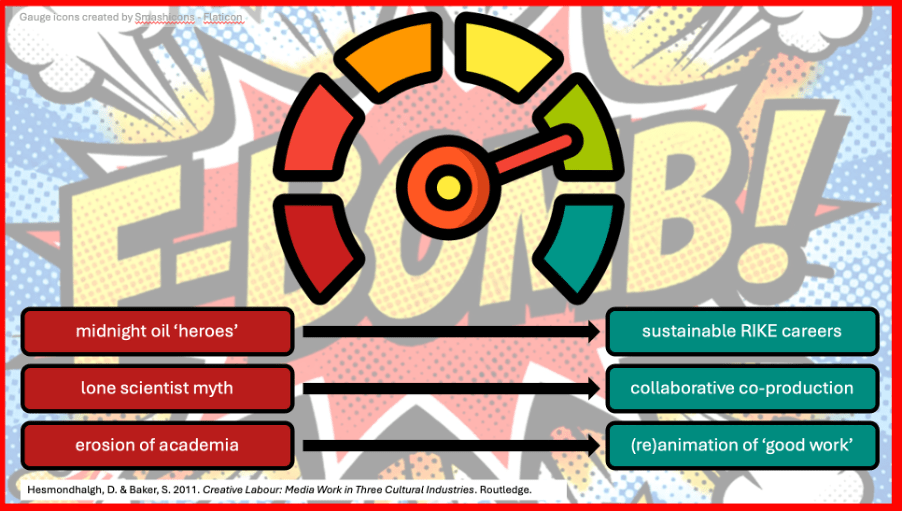
To conclude: how does play help us shift the dial on research cultures?
Recalling Bakhtin: we know that fun can invert the normal social order only temporarily, but ideally for long enough for people to see things differently, and to question taken-for-granted norms, such as whose voice counts as an authority, what skills are needed for RIKE success, and what does a ‘good’ RIKE career look like?
With fun in the researcher development toolbox, we’re trying to shift the dial away from dominant hero narratives of researchers burning the midnight oil, and the myth of the lone scientist, towards more sustainable ideals of RIKE being a journey not a sprint, and of impactful research with genuine potential for real world impact, because it is the outcome of collaborative co-production with stakeholders and end users.
Higher education can be a pressure cooker, with multiple systemic issues eroding the quality of academia. Bringing fun into researcher development—through careful design and thoughtful deployment—is one small way to try to re-animate the idea of academic labour as ‘good work’. Per David Hesmondhalgh and Sarah Baker (2011), ‘good work’ is labour that supports human flourishing. Work that involves autonomy, sociality, and interest; work that affirms self-esteem and self-realisation; work characterised by its balance with the rest of life, and by security.
Dropping the F-bomb can’t fix everything, but it might help shake things up just long enough for us to glimpse a better version of the order of things.
As I said: researcher development is a team sport. RIKE takes a village! Let me also therefore thank colleagues past and present at Sheffield Hallam University; Christine Bell, Centre for Facilitation; and Laura Evans-Hill, Nifty Fox Creative.
References
- Bakhtin, M. 1984. Rabelais and His World. Indiana University Press.
- Cimino, S., Maremmani, A.G.I. & Cerniglia, L. 2025. Discontinuation of classic toy play vs. digital play among 8-10-year-old children: A systematic scoping review. Societies 15(12): 354.
- Elias, N. & Dunning, E. 1986. Quest for Excitement: Sport and Leisure in the Civilizing Process. Blackwell.
- Hesmondhalgh, D. & Baker, S. 2011. Creative Labour: Media Work in Three Cultural Industries. Routledge.
- Huizinga, J. 1950. Homo Ludens: A Study of the Play-Element in Culture. Beacon Press.
- Podilchak, W. 1985. The social organization of fun. Loisir et Société 8(2): 685–691.
- Simmel, G. 1972. Sociability. The Sociology of Georg Simmel. Ed. K.H. Wolff.The Free Press.
- Stebbins, R. 2001. Serious leisure. Society (May/June): 53-57.
Visuals
- Pieter Brueghel the Elder. Children’s Games 1560; The Fight Between Carnival and Lent 1559.
- Icons from Flaticon: ritual icon by spacepixel; repeat icon by Amazona Adorada; internet icon by Freepik; gauge icon by Smashicons
- F-Bomb, Pressure Cooker, Tree images: AI-generated (ChatGPT, OpenAI), January 2026
 Researcher Education and Development Scholarship Conference
Leave a comment