By Natalie Quinn–Walker, Deputy Course Leader and Senior Public Health Lecturer, and Dr Ana Mejia–Mejia, Public Health Lecturer, Birmingham City University, UK.
This post draws on our recent publication ‘Student Partnership and Peer-Led Learning: Applying the Ketso Method in Public Health Education in Innovations’ (Quinn-Walker and Mejia-Mejia, 2026) in Innovations in Pedagogy and Technology.
In our Master of Public Health dissertation module, we began to explore ways to help students refine their research questions and organise their ideas. We noted that some students struggled and needed additional support and we conducted a study to identify the specific challenges. Recurring issues included feasibility, narrowing ideas, defining inclusion and exclusion criteria, and organisation; thus, we introduced a facilitation method called Ketso (Tippett, 1995), a toolkit which offers an opportunity for a hands-on approach, promoting inclusive discussion.. Our pilot project introduced Ketso workshops, in which students would share their research ideas and structure their thinking to refine their systematic review.
Ketso, a tool to promote a collaborative approach
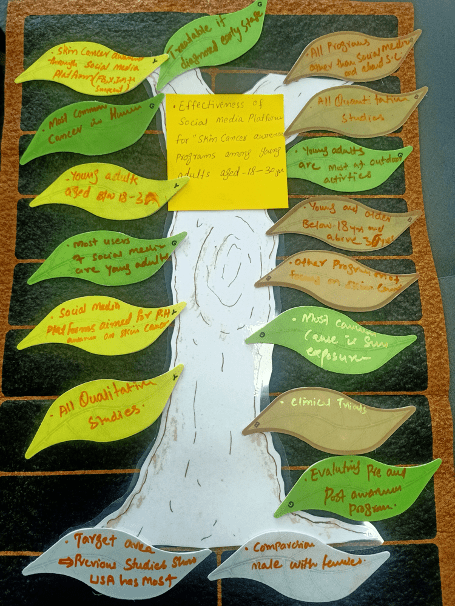
Ketso enables individuals to work together to generate and organise ideas through structured discussion. The toolkit includes colored leaves, which are placed on a felt mat to visually map ideasallowing participants to change and evolve concepts through discussion, creating visual aids that reveal connections between ideas.
A key foundation of this approach was to create a collaborative environment that encouraged visual thinking. Rather than discussing ideas, students had to physically map them. This enabled them to rearrange their ideas, easily see the relationships between concepts, and identify gaps in the research to establish why their research needed to be investigated.
Students then interacted with their peers to promote their ideas and determine whether any further clarification was needed. During the discussion segment of these workshops, it was helpful for them to consider alternative perspectives and, if needed, further redefine their research focus.
The pedagogical value of peer-learning has been well established (Carlson et al 2019) and systematic literature reviews on the value of peer teaching in health profession education have highlighted the effectiveness of peer teaching methods in improving procedural skills (Zhang et al, 2022) such are those involved in dissertation planning. Suyo-Vega et al (2024) see peer involvement not only as an innovative pedagogical practice but also as a valuable student-centric teaching strategy.
How we used Ketso
In our Master of Public Health course, students are taught research methods, attend dissertation workshops, and, after supervision, must complete a systematic review. We used Ketso to help students explore their ideas for this review. We further developed projects and tested peer-led learning as described in Quinn-Walker and Mejia-Mejia (2026).
The Ketso workshops were optional two-hour sessions, with up to 10 students per session. These small groups ensured students felt supported and could develop their ideas. Each coloured leaf represented a different aspect of the research planning process:
- Yellow leaves – inclusion criteria: which studies will be included.
- Brown leaves – exclusion criteria: which the studies will be excluded.
- Green leaves – arguments and justification: reasoning why this research needs to be investigated.
- Grey leaves – questions and uncertainties: students note areas needing further support or clarification
This structured approach allows students to visualise their research design, identify gaps, and examine the overlay in areas that need further clarification. Small group discussions were a key foundation of the pilot project. The students were able to share ideas, ask each other questions and provide feedback on each other’s projects
Participation in the Ketso workshops was strong across programme cohorts. For example, within one intake, 65 students attended sessions linked to the research methods module and 75 attended sessions supporting the dissertation module. A later intake included 40 research methods participants and 51 dissertation participants. Although these numbers are small and should be interpreted with caution, they indicate early positive effects on student engagement and progression.
Notably, after introducing the workshop, attention rates increased, and first-submission failure rates decreased. Ninety per cent of students passed their dissertations on the first submission, and forty per cent achieved a distinction.
Student feedback was consistently positive. All participants reported that the sessions helped them organise their ideas and develop a more effective approach. Some students described the workshops as interactive and engaging, as well as a fun, practical way to work through their dissertations.
This is all positive news as for students, their dissertation journey can be quite difficult, as they have to develop an idea and complete a systematic review within a short period of time. Having the opportunity for them to attend a workshop that helps them broaden their thinking about the mapping of their assessment, creates a more structured visual approach, and helps them navigate their dissertation progression. We have previously noted (Quinn-Walker, 2026) that the workshops enable students to build a network of interconnected decisions rather than viewing the dissertation as a linear task.
A scalable model
As this was originally a pilot to assess whether the workshops would be beneficial, we have been encouraged to utilise them, and we have conducted further research since the original project. We’ve found continuous success and benefits for students. We have conducted further research, including the peer-led project, and have also introduced the workshops into other modules to further support and develop them. Further work will explore the long-term impact of the workshops on dissertation development, including student confidence, research skills and overall dissertation outcomes.
 Researcher Education and Development Scholarship Conference
Leave a comment