Dr Teresa Phipps, Postgraduate Research Service, and Dr Emily Lowthian, Department of Education and Childhood Studies, Swansea University, UK
In a world of journal articles and academic textbooks, the Three Minute Thesis (3MT) competition offers an exciting and challenging mode of communication. With just three minutes and one slide to communicate the value of their doctoral research, students are met with the challenge of condensing a long, complex project in a way that is engaging and impactful for non-specialists. The competition responds to the need for lay-communication of academic research, both for improving oral communication skills and for encouraging doctoral researchers to consider the social, industrial and commercial value of their thesis. It is also hoped that confidence in communication improves through the practical experience of taking part in the competition and taking on the challenge of distilling the key messages of their project in this way.
Time and again, Three Minute Thesis participants seem to grow in confidence and communication skills, but is this just our perception, or is there empirical evidence behind it? In this blog piece, we outline findings of our case study of the impact of the 3MT competition and training programme at Swansea University.
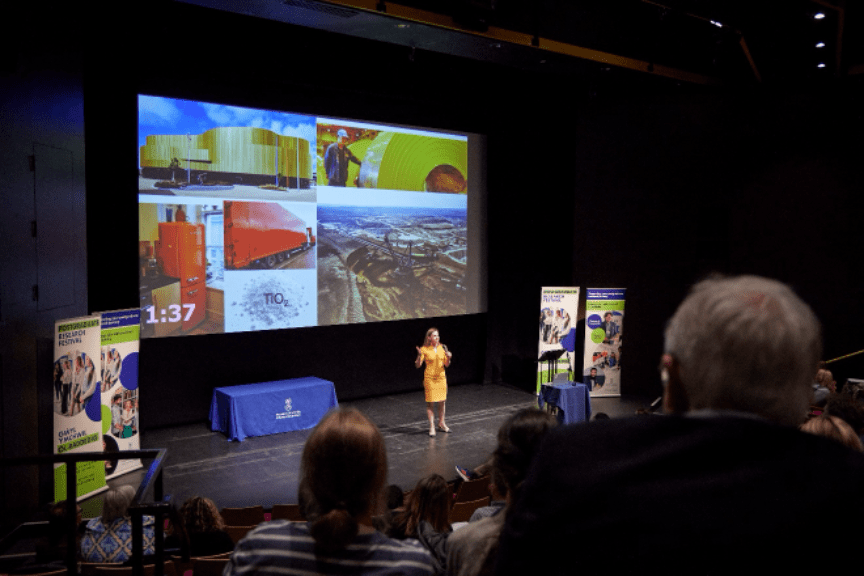
3MT at Swansea University
We offer support and training to doctoral researchers in preparing for 3MT, compromising analysis of past presentations, qualifying judging rounds, and one to one feedback. Our project sought to explore whether we could generate data to interrogate our assumption and anecdotal feedback from participants that 3MT is a positive experience and understand more about the impact of participating in 3MT. We focused on three main research questions:
- Do doctoral students’ perceptions of their confidence, enjoyment of presenting research, and ability to communicate with different audiences change over the course of the 3MT competition?
- How do doctoral students reflect on their research communication?
- Is there a change in doctoral students’ general self-efficacy over the course of the 3MT competition?
How did we evaluate the 3MT experience
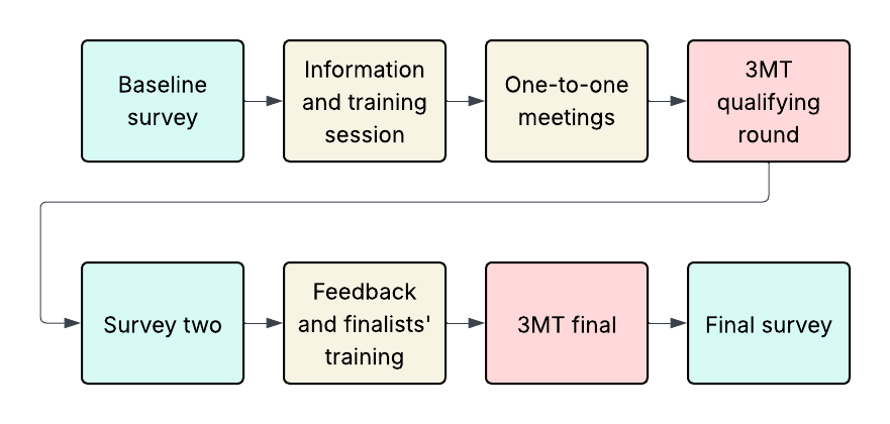
We designed a mixed-methods longitudinal survey, consisting of closed questions using a Likert scale (‘Very confident’ to ‘Not very confident’) and one open free text question. By collecting numeric and free-text data we were able to determine measurable differences in attitudes and behaviours, along with more nuanced understandings of the 3MT process. The survey was repeated at three time points across the span of the competition in 2024. The first took place during the initial information and training session, the second following the qualifying round where participants delivered their presentations for the first time, and the third following the university-wide final with an audience of approximately 150 people. We had 19 participants in our study, which reflects the number of doctoral researchers who participated in 3MT.
Quantitative findings
Our quantitative findings showed significant increases in confidence, with 80% of participants feeling ‘Confident’ presenting their research by the end of 3MT. We also saw a 60-percentage point increase in their intentions to seek out opportunities to present research, along with increases in the ability to adapt research communication, identifying the needs of audiences, describing the significance of their research and general self-efficacy. However, the enjoyment of presenting research had only increased 33 percentage points, and perhaps this might be because those who sign up, already have a predisposition towards disseminating research.
Individual reflections on presenting research
As well as closed questions, we asked doctoral researchers to describe how they felt about presenting their research – an intentionally broad question to gain wide-ranging reflections on the process. This data corroborated the quantitative findings, while also adding nuance through individual reflections, particularly on the contextual nature of confidence and nerves.
Discussions of increased confidence were a strong theme; one participant reflected that they felt “more confident than before, being able to summarise my thesis in a short time has helped me relate it to different audiences.” For many, nerves coexisted with confidence, evidencing that an increase in confidence does not always mean the absence of nerves, and that these feelings could be specific to a particular context. A common feature of nerves was the presence of the audience, as well as concerns about communicating specialist concepts, for example “[I] feel very nervous about getting it perfect”, perhaps reflecting the high-profile nature of the competition, and the ambitious character of many doctoral researchers. After presenting, participants still showed some hesitation “still not sure if I managed to make the presentation correspond to the level of audience knowledge”. However, this was not always reflective of a negative experience: for one participant “it was scary, but I really enjoyed presenting my research in the end”.
As well as reflections on nerves and confidence, participants shared their enjoyment of presenting their research, finding it can be fun and enhanced their ability to see the ‘big picture’ behind their work. Others valued the opportunity to “step out of my comfort zone”, particularly where English was a second language, or presenting was new to them. Comments such as these demonstrate the value of stepping away from the traditional means of communicating research, and that fun and enjoyment can exist even when individuals are nervous or lack confidence.
Conclusions: measuring researcher development
Taken together, our data demonstrates the tangible impact of participating in 3MT as part of a programme of training and support, through which there was significant change to doctoral students’ skills, feelings and behaviours relating to communicating their research. Despite clear positive changes in statistical measures, progress was not necessarily linear, with mixed individual reflections on the experience.
Beyond 3MT, the project has demonstrated the value of conducting research to generate deeper insights into the impact of researcher development beyond standard evaluation forms. Through our collaboration, this project enabled us to blend researcher and practitioner expertise, learn from a range of research approaches, and gain access to doctoral researchers. This was a rare opportunity for meaningful exchange across parts of the institution that do not often work closely together. As a result, project findings can be implemented relatively quickly to ensure timely and meaningful impact. Since completing this research, we have retained our focus on helping participants sharpen their key messages and consider the needs of their audience, particularly through one‑to‑one support with script development. We have also introduced sessions with a public speaking coach to give participants practical confidence‑building tools.
 Researcher Education and Development Scholarship Conference
Leave a comment