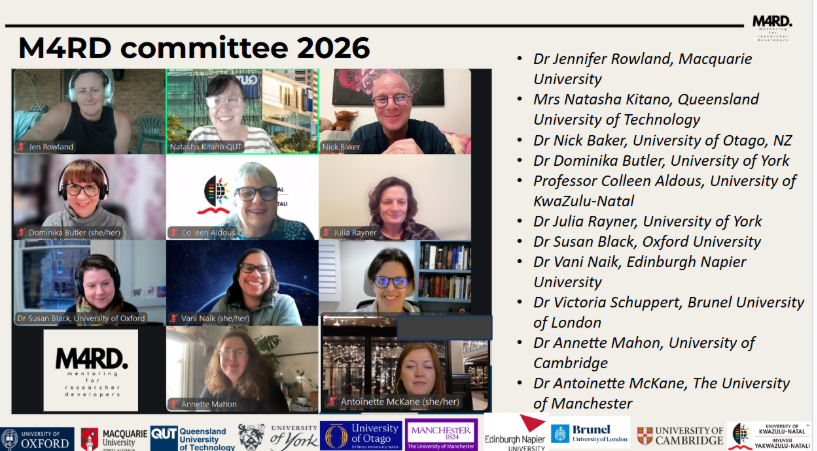
Mrs Natasha Kitano, Queensland University of Technology, Australia ORCiD; Dr Vani Naik, Edinburgh Napier University, Scotland; Dr Antoinette McKane, University of Manchester, England ORCiD; Dr Susan Black, University of Oxford, England, ORCiD; Dr Jennifer Rowland, University of Macquarie, Australia, ORCiD; Dr Victoria Schuppert, Brunel University of London, England; Dr Annette Mahon, University of Cambridge, England; Dr Dominika Butler, University of York, England; Dr Julia Rayner, University of York, England; Professor Colleen Aldous, University of KwaZulu-Natal, South Africa, ORCiD; Dr Nicholas (Nick) Baker, University of Otago, New Zealand, ORCiD.
Mentoring for Researcher Developers (M4RD) is an international 1:1 mentoring scheme for researcher developers which runs every year from May-October. M4RD is designed for anyone working in a researcher development role and covers a variety of job titles, ranging from Academic Developer, Research Development Officer to Professional Practice Fellow. The only requirement is that a key part of the role is to support the personal and professional development of researchers. Researchers include doctoral candidates, postdoctoral researchers, research assistants, research staff and academic staff whose portfolio includes research. To date, this scheme has been running on an entirely voluntary basis by current and past mentors and mentees, with no funding support.
The creation of M4RD has been timely as researcher development has emerged as a recognisable field of practice (Miles, 2025). In a recent report commissioned by Vitae, Johnson et al (2025) argue that researcher development activity is a crucial factor for building the skills, knowledge and capability required to enable and deliver excellent research. As Merga and Kitano (2026) show, researcher development is also increasingly embedded within academic career expectations, with promotion to associate professor in Australia often requiring contributions to mentoring, training, and building the research capacity of others. In the UK, many researcher development roles tend to be situated within professional services structures and are emerging as a third-space profession (Freeman & Price, 2024).
M4RD was born out of a recognition that this field was developing and growing at a fast rate, and better support for this profession was needed, given its nascency. Since its inception in 2022, M4RD has continued to grow in numbers and expand in reach. Our network currently spans 6 continents, 25 countries, more than 100 institutions and 280 participants – many participating annually. This global reach is reflected in participant experiences, with one noting “the value of building connections with RDers worldwide.” What began as a regionally focused initiative across the UK, Australia, South Africa and New Zealand has evolved into a genuinely global community of researcher developers.
The M4RD committee
The 2026 M4RD committee represent 10 universities around the globe, spanning the UK, Australia, New Zealand and South Africa. We volunteer our time in this non-selective community driven scheme, coming from research-intensive as well as teaching-intensive universities. In recent years, there has been a consistency in membership which has strengthened with each iteration of M4RD. Our genuine desire to improve M4RD is one of the hallmarks of this mentoring scheme.
M4RD the process
As a committee, we create and ensure the sustainability of this mentoring scheme through a clear process:
- Recruit
Recruiting researcher developers is the first step. The engagement plan includes the following: advertising on LinkedIn, using relevant email distribution lists, such as the International Doctoral Education Research Network (IDERN), Researcher Development Scholarship, Researchers14, Staff Development Forum, as well as through more local researcher development networks, including the UK South-east Researcher Development (SERD) network, the Australian Doctoral Writing Discussions (DWD) community, and the New Zealand University Researcher Development Interest group. We then request willing participants to complete a survey form answering key questions around their background and expectations. Providing comprehensive answers on this form is vital for the matching process.
- Match
M4RD offers a unique human element when matching the mentor–mentee pairs. Members of the organising committee take time and care to create the best matches across institutions, countries, time-zones and specialities based on the information that our mentor and mentee applicants provide. While there is mentoring matching software available, as researchers and researcher developers, we enjoy getting closer to the data, in reading and understanding who the mentors and mentees are, as that allows us to better support them throughout the annual six-month mentoring scheme. Feedback from participants highlights the practical value of these relationships. As one participant noted, “My mentor and I were an ideal match… we both gained a great deal from the experience.” Also, as one mentee reflected, “It was good to have someone external to talk to… my mentor helped me realise that something isn’t my job and I should hand it back, which was massively helpful.”
- Support for Mentors and Mentees
A monthly event is held throughout the six-month mentoring period. The first and last events are hosted by the M4RD committee to welcome participants in May and to close the programme in October. The welcome event is a time when we provide guidance on the giving and receiving of mentoring, as there may be differences in approach to other mentoring initiatives participants have engaged in. M4RD specialises in creating 1-1 mentoring partnerships, and we therefore pride ourselves on providing a comprehensive induction to the scheme to ensure that mentors and mentees start their relationship with a similar set of expectations. Feedback from participants highlights the value of this initial introduction. As one participant reflected, “Meeting other mentors and learning about mentoring… [it was a] great opportunity to learn,” while another emphasised the importance of early connection, noting the benefit of “meeting others in the program” and the “warm interaction” that set the tone for the scheme. Moreover, the welcome and closing events enable mentors and mentees to meet others engaged in the initiative in a group environment. Breakout rooms are provided in these online sessions to enable mentors and mentees to share their thoughts in a communal group environment. To foster a more community environment, prior to the welcome event, we invite participants to introduce themselves on our yearly M4RD Padlet, which also acts as a one-stop shop for resources to be shared as a community.
- Support for the Wider Researcher Development Community

The remaining four monthly events in this programme are hosted by a sister initiative, Network of Researcher Developers (NeRDs), which offers a wider opportunity for researcher developers to engage in professional development activities and networking online. These activities extend beyond those directly participating in the mentoring programme. One participant noted that NeRDs offers “a great networking experience ..to meet other people in the program beyond our mentor”. These online sessions include professional discussions, collective reflections, peer learning and opportunities to make connections. For example, in 2025, NeRDs held sessions on AI in researcher development, as well as a very popular session on the use of memes in researcher development by Australian researcher developers Tseen Khoo and Meagan Tyler. There was a competition for best meme, and this was the wining meme.
Both M4RD and NeRDs provide a transnational space for the emerging profession of researcher developers to meet and connect across diverse higher education contexts globally. M4RD continues to evolve through successive mentoring cycles, supporting new mentor-mentee partnerships across an expanding international community, while NeRDs offers open events that provide ongoing opportunities for connection, dialogue and professional learning. As a fully volunteer-led initiative, the strength of M4RD lies in the commitment of its community. As one participant observed, “This is a volunteer run scheme… the passion of those involved is what has made it a success.” We warmly invite you to take part in both M4RD as a mentor and a mentee, and to attend NeRDs events. The best way to stay informed of our events is through our LinkedIn pages for M4RD and NeRDs. We look forward to connecting with you!


Leave a Reply