By Dr Swathi Mukundan, Dr Lennie Foster, Sharon Henson, Dr Kathryn North, and Dr Vivien Chow, Loughborough University, UK
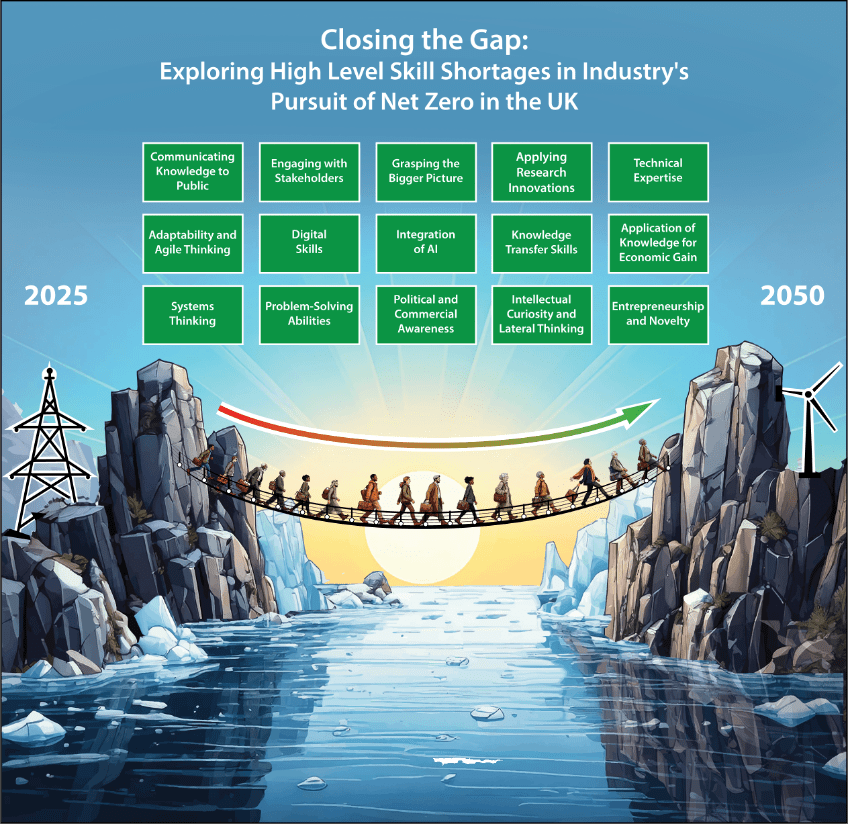
Imagine a workforce problem so large it has its own number. The Green Jobs Taskforce puts it at 120,000 – this being the additional skilled employees the UK will need in net-zero sectors to meet the 2050 climate target (Green Jobs Taskforce, 2021). Now consider that the UK already has over 50,000 doctorate-holding Research Staff whose expertise spans exactly the technical and scientific domains that those sectors need. On paper, this should be a simple match. In practice, it is anything but.
Our research at the Centre for Postdoctoral Development in Infrastructure, Cities and Energy (C-DICE) set out to understand why the mismatch persists, and what a more creative approach to developing researchers might do to address it.
What employers said
We ran focus groups with 20 industry stakeholders from energy, manufacturing, construction, and consultancy sectors, asking them directly how they perceive the readiness of doctoral-level researchers for net-zero roles. The full findings are published open access in Cleaner Engineering and Technology (Mukundan et al., 2025).
Employer enthusiasm to solve this problem was strong. One participant from the nuclear sector was unambiguous: “We probably need 120,000 more employees… our biggest challenge is high-level skills recruitment.” Research Staff, in their view, bring genuine analytical firepower that industry struggles to replicate. And yet, the same employers described doctoral researchers as ‘underprepared’ for the roles they most urgently need to fill. The problem was not the depth of technical knowledge; it was everything that surrounds that knowledge.
Where current training falls short
Using thematic analysis mapped to the Vitae Researcher Development Framework (2011), we identified six areas where current doctoral training consistently falls short of employer expectations for net zero roles: systems thinking, strategic communication, cross-sector collaboration, leadership, commercial awareness, and policy literacy.
It is worth pausing on what this list represents in terms of creating doctoral graduates ready to tackle this global need. It means a shift in how we think about what is core to academic training, and what is ‘nice to have’ – these skills can no longer be seen as peripheral. As one employer put it: “Systems thinking is a big issue; it’s about collaboration across boundaries.” In net zero job roles researchers need the ability to think across environmental, economic, and operational dimensions at once; to communicate research to a room full of procurement managers or local authority officers; to navigate the difference between enjoying academic independence and commercial accountability: these are the capabilities that determine whether a researcher’s work actually changes anything when it comes to net zero. And we don’t get them from taking an inward-looking approach to completing a research project. None of this reflects a failure of individual researchers. Academic training has been deliberately designed to produce publications and disciplinary depth, and we need to rethink that.
Four ways to get creative
Rather than treating skills gaps as fixed features of the landscape, we asked stakeholders what they would want to see in a doctorate that increases the readiness of researchers for net zero roles. What emerged were four categories of intervention, each one a genuine departure from how doctoral and post-doctoral development is typically structured.
1. Experiential Learning
Placements, secondments, and work-integrated learning pathways offer something no classroom-based workshop can replicate: the experience of operating in a different environment. One stakeholder pushed this further than most: “Researchers should be forced to do 3 to 4 placements in different organisations to build adaptability.” The UK’s increasingly common collaborative Doctoral Training Programmes and industrial doctoral schemes offer us templates for how to achieve this, and show it is achievable within the doctoral project timeframe. The challenge is extending the benefits of placement-based learning to Research Staff who are already mid-career. Both perceptions of the value of placements for Research Staff, and contracts of employment complicate this, but neither is insurmountable.
2. Structured Support
Cross-sector mentorship networks, Impact Fellowships (of which there are many examples) that provide connections between universities and industries/communities, and the establishment of Industry Advisory Boards in academic Schools/Departments offer the kind of sustained relational support that shapes a more rounded and contextualised researcher identity over time. This requires us to think differently as developers, focusing less about delivering content to researchers, and more about facilitating and sustaining connections between academia and the UK’s industries.
3. Skills Development
Business acumen, intellectual property awareness, and leadership development are rarely embedded in doctoral or post-doctoral training in a meaningful way. Making them credit-bearing, externally accredited/benchmarked, and making them required components rather than optional extras would be a signal that institutions are taking the full range of what researchers need to thrive beyond academia, seriously.
4. Collaborative Approaches
Co-designed research projects, interdisciplinary research teams, and durable university-industry partnerships all create the conditions in which collaboration skills are not taught but developed in practice. Global models point to what sustained investment in this kind of infrastructure looks like: Germany’s Fraunhofer Institutes, the UK’s Catapult Centres, and the MIT Industrial Liaison Program each demonstrate that bridging the academic-industry divide is not idealism, it is a design choice.
A culture problem as much as a skills problem
What connects all four of these approaches is the same underlying argument: the way we currently develop doctoral researchers reflects a set of cultural assumptions that no longer fit the challenges we are facing. Mobility, applicability, collaboration, and impact are not soft add-ons to a research career. For net-zero transitions specifically, they are the core.
There is something important in the timing of this. Net-zero workforce demands provide a concrete external driver that is hard to ignore. Climate targets, green jobs policy, and industry skills shortages together create shared goals and a shared vocabulary between universities, funders, and employers that has not always existed. That is an opportunity for researcher developers to wield the wealth of emerging evidence to make meaningful structural change.
At C-DICE, we have translated these findings into practical and specific actions for universities, industry partners, and policymakers. You can read more, open access, in Cleaner Engineering and Technology (Mukundan et al., 2025).
The redesign we owe researchers
Here is what our research ultimately argues: the question is not whether doctoral-level research staff have value for the net-zero transition. Of course they do. The question is whether our institutions are willing to redesign the conditions that currently prevent that value from being realised.
Adding more workshop-based learning will not solve the problem. The redesign that is needed is structural: mobility embedded in contracts, cross-sector impact being recognised in research assessment, development programmes that are co-designed with industry, and a genuine expectation that researchers will seek diverse experiences rather than treating such experiences as a distraction from ‘real’ academic work.
The net-zero challenge is, among other things, an invitation to rethink what a research career can look like. The 120,000 figure is not just a workforce statistic. It is a prompt. And researcher developers are well placed to answer it.


Leave a Reply