Dr Aoife Sadlier, (ORCiD | LinkedIn) Participatory Research Officer, Queen Mary University of London, UK and Associate Lecturer in Sustainability in Practice, MLA College, Plymouth, UK.

Introduction: Research Professionals’ emotional labour
This post explores the emotional labour experienced by Research Professionals (RPs) – those who support research across a range of roles, from public engagement to research management and research culture (Grant and Kennie, 2024).
Hochschild (1983) defined emotional labour as the management of one’s emotions to present oneself in a certain way, especially – although not limited to – when one is performing a service-oriented job. This concept is particularly relevant to RPs’ experience within the UK’s marketised Higher Education sector.
RPs operate within a third space (Whitchurch, 2008), which presents opportunities for maximising knowledge-sharing, while embodying precarity, due to shifting institutional and sectoral priorities. This post highlights how RPs are not always valued as peers and puts forward solutions for addressing this issue.
My journey with this topic
As a researcher and educator with expertise in participatory research, a collaborative form of investigation that involves communities with direct experience of an issue to shape change (Vaughn & Jacquez, 2020), a couple of questions have long interested me. How can we create more equitable research cultures? How can we ensure all staff who enable research gain recognition?
From 2025 to 2026, as I faced a crossroads in my career – feeling like a failed academic, fledgling RP and emerging fiction writer – these questions prompted me to lead my own research project, titled ‘Reframing the Research Professions’. The project was supported by the Enhancing Research and Innovation Cultures (ERIC) fund at Queen Mary University of London (QMUL).
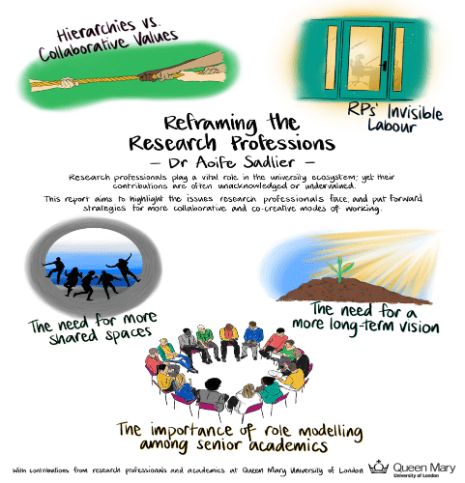
The rationale was that RPs are a vital part of the university ecosystem; yet their contribution is often unacknowledged. This can lead to power imbalances when working with academics (Gourlay, 2025), problems with professional identity (Jack, 2025) and feelings of lower perceived worth (Toogood, 2025). As I have experienced, these issues are particularly marked for those transitioning from academia to the research professions (Anonymous Academic, 2017).
At QMUL, the divide between academics and RPs is increasing, with professional services staff numbers being reduced at a faculty level. Inspired by ARMA 2020 survey recommendations, the project sought to establish a peer network where RPs could explore relevant issues and provide mutual aid. Concurrently, it aimed to create dialogue between academics and RPs, to ensure everyone felt valued.
Supplementary interviews/focus groups with RPs (n=7) and academics (n=3) offered further insights into opportunities, challenges, values and co-creative strategies, which informed the ‘Reframing the Research Professions’ report. Material from this report is discussed in the following sections.
Keeping the ship afloat
RPs’ emotional labour manifested in three ways: doing invisible work; being treated like admin assistants; and not receiving direct feedback.
As one senior RP highlighted, RPs do a lot of hidden work. They enable something fundamental to happen and nothing goes wrong. In some ways, this is a success ‘because the ship keeps on sailing happily through the waters. It doesn’t sink’ (IRP3). However, this also creates an expectation that RPs’ work should remain invisible, which is far from equitable.
The above point links to RPs’ professional invisibility and the devaluation of their skillset (Allen-Collinson, 2009). RPs possess strong organisational and relational skills, honed through working across teams and staff groups. However, a stereotype prevails among some senior academics that people become RPs because they are not cut out for an academic career.
One RP who had transitioned from academia was made to feel like an ‘admin assistant’ who had ‘gone back ten years’ in his career and was ‘just doing some odd, petty jobs for an academic’ (see also Pilgrim-Brown, 2024).The core issue was a lack of respect. As he explained: ‘I was talking to a Professor, having a nice chat and then they’re like, “Oh, can you get me a coffee with two sugars?” And I’m like, I will. But this is awkward’ (IRP1).
RPs’ emotional labour is also connected to a lack of direct feedback. As a senior academic highlighted in a focus group discussion, he gets ‘lots of ego strokes and very immediate feedback’ (FG2A1); yet an RP stated that she only experiences this when working on specific projects. She is currently running a six-month programme for early career researchers and feels ‘buoyed – getting that direct feedback’; with the everyday ‘behind-the-scenes things’, though, there is generally ‘a lack of display’ (FG2RP1).
However, increased visibility does not necessarily equate to an improved research culture. As another RP highlighted, arguably the core issue is that academics do not always value RPs as peers. Her method for achieving impact was to influence academics to the point that they repeated back an idea she had presented to them previously. While she was happy to have shaped a tangible outcome, when I probed, the burden was revealed: ‘But does it affect you emotionally? Yes, of course it does’ (IRP3).
Next Steps
Below are some actionable steps that could remove the burden of emotional labour and ensure RPs are valued as peers:
1. Senior academics and leaders need to become more steadfast role models (Nath et al., 2018). As one RP expressed: ‘They have a really clear responsibility to create a working culture where everyone feels recognised’ (IRP4).
One example of good role modelling was presented by a senior academic who makes her colleagues aware of different career pathways. However, as she acknowledged, ‘that’s taken a lot of time and experience’ (FG1A1). Acquisition of role-modelling skills therefore needs to be built into academics’ career trajectories.
2. All staff should have the opportunity to lead change. Changemaking courses could be offered (Costa, 2024), as well as trainings that bring staff from different strata of the university together. The latter could emphasise a sense of creative collaboration and play (Smith Maguire, 2026). Just as Carnival achieves, by enabling social stratifications to break down, we can hopefully open up a space for cultural change.
3. Trauma-informed approaches (McCloughry, 2024) and the principles of equitable partnerships (NCIA & QMUL, 2024) should be mainstreamed, so senior leaders are aware of different staff groups’ vulnerabilities, and can work transparently with them during times of precarity.
4. A more formal pathway to recognising RPs’ diverse skillset could bolster self-esteem. For instance, staff could be supported to gain accreditation via relevant professional organisations (e.g., ARMA) and recognition via internal skills frameworks. Equally, RPs should continue to find spaces (online and/or in-person) to celebrate their skills.
5. How we talk about roles matters. A terminological shift from ‘professional services staff’ to ‘professional enabling staff’ would move the focus from RPs’ service contribution to how they enable fundamental work to happen.
Concluding thoughts: let’s rock that boat!
While undertaking this research, a few senior RPs stated that I was ‘trying to challenge the status quo too much’. However, I think it is important to rock the boat, otherwise we will keep replaying the same old patterns of working and relating. Therefore, here is my (perhaps utopian!) vision for RPs within Higher Education:
Increased visibility for RPs needs to be accompanied by genuine cultural change and an alignment of values, otherwise RPs will continue to exist in the shadows.
 Researcher Education and Development Scholarship Conference
Leave a comment