Dr Heike Miess, OD Associate People Partner and Emma Chandler, OD Officer, University College London
Early career researchers are the future and the talent pipeline for the academic ecosystem. As such, Kenny et al. 2024 rightly argued that supporting and empowering this key population to become confident and resilient leaders will set them up to face future challenges and shape a research ecosystem that works for them, that meets their needs as future key players in the Higher Education system.
Furthermore, they argue recognition is “not merely a form of validation but a powerful catalyst that fosters innovation, collaboration, and cultivation of a new generation of leaders in research.”
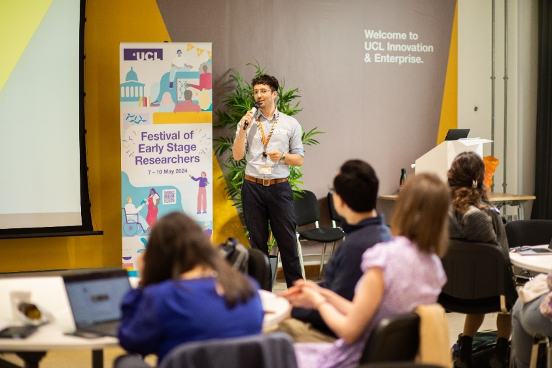
One way this commitment for recognition, empowerment and support is realised in practice is through dedicated institutional initiatives such as the UCL Festival of Early-Stage Researchers.
The Festival of Early-Stage Researchers
The Festival of Early-Stage Researchers (FESR) was first established in 2019 as part of Postdoc Appreciation Week. Since then, it has grown into a central element of UCL’s support for early career researcher staff and doctoral researchers (in the following referred to as early career researchers or ECRs). Its purpose has remained consistent: to recognise, celebrate, and meaningfully support researchers navigating the early stages of their careers.
Over time FESR has become a valued milestone, offering opportunities for career development, networking, (skills) growth, and knowledge exchange.
Co-creating the Festival with the community
As the festival is for early career researchers, it was obvious to consult with this group to develop a programme that works for them. To this extent, we recruited 32 volunteers (18 doctoral researchers and 11 early career researchers) to join the FESR 2025 organising committee via an open call.
ECRs joined the organising committee to meet researchers from other fields and to expand their network, to feel connected and increase their sense of community and to give back to the UCL community.
To engage and keep momentum across the organising committee, we were inspired by Vitae’s Toolkits for developing and sustaining researcher networks (Leech et al, 2022). We developed Terms of References to outline the purpose and scope of the committee as well as roles and responsibilities. Fortnightly meetings were held initially online and later hybrid to allow participation of ECRs near and far. We employed digital whiteboards for committee members to share their thoughts anonymously during and in between meetings to maximise and amplify their voices and contributions to FESR planning.
Involving early career researchers in the planning allowed them to shape the Festival to meet their needs and the needs of their peers and gain hands on experience in strategic thinking, stakeholder engagement, project management, and facilitation. This collaborative approach firmly positioned FESR as an event created by ECRs, for ECRs.
Co-development ensured that the Festivalstayed relevant, engaging, and truly reflective of early career researchers’ priorities. Furthermore, we hoped to ignite a community spirit amongst the volunteers which would be transferred to the Festival participants on- and off stage.
Motivation to join the Festival organising committee and reflections
Of the 32 organising committee members recruited, 12 sustained their involvement throughout, demonstrating ownership by co-creating sessions, serving as panel members or hosts, and actively contributing to the successful delivery of events.
Committee members found the experience incredibly rewarding and said it strengthened their sense of belonging. To quote one member: “I also enjoyed getting a sense of accomplishment out of something outside my regular job.” Volunteers appreciated the opportunity to develop new skills, to meet and work with researchers from different fields and to getting to know the university and its structures better.
Festival Programme and reception
FESR 2025 was held over five days stretching over two weeks. The festival consisted of twelve sessions grouped into five themes as depicted in the following table. Highlighted in bold are panel sessions facilitated by members of the organising committee. Highlighted in italics are panel sessions co-created with members of the organising committee.
| Day | FESR theme | Session Title |
| 1 | Working across disciplines | Getting started with working across disciplines |
| 2 | Commercialising your research | Research to Market |
| Pitching your research | ||
| 3 | Planning your career (hybrid) | Global Mobility |
| Unconventional careers outside of academia | ||
| Research-associated careers in HEIs | ||
| 4 | Publishing your research (hybrid) | Publishing in the time of AI |
| Decreasing Frustrations in the publishing process | ||
| Re-imagining peer-review | ||
| Zine making | ||
| 5 | Thriving as a researcher | Thriving as a researcher |
| Community Celebration | Community celebration at the Petrie Museum |
We were reassured and delighted to see that the programme that we co-designed and delivered resonated with the vast majority of FESR participants. 85% of the FESR participants who submitted their feedback agreed that the advertised content matched their expectations, while 89% said they would be able to use the knowledge and techniques covered in the sessions in future scenarios. Furthermore, 95% of participants thought that the facilitators created an engaging, inclusive and accessible learning environment, which was one of the key success measures of the event and once again fully reflected the co-creation at its core.
Sharing some participant voices:
“Well balanced panel and engaging speakers.” (Decreasing Frustrations in the publishing process)
“Seeing a wide range of different backgrounds from the panel gave very useful insight.” (Global mobility)
“It’s a very useful event for ECRs.” (Zine making)
Reflections from our (Researcher Developer) perspective
Co-developing and -organising FESR with the early career researcher community was an interesting experience which involved more steering and engagement efforts than expected. The organising committee was comprised of a wide breadth of experiences both in background and skills, which resulted in lively discussions around shared themes of interest. However, reaching consensus on decisions was difficult and therefore, they were reached through democratic voting or executive decision making at critical points.
Furthermore, it soon transpired that ECRs are notoriously time poor and subject to frequently changing priorities, while often having limited on-site availability. This resulted in volunteers dropping off from the organising committee over time and with most of the tasks being carried out centrally to ensure continuity and delivery to time and budget.
 Researcher Education and Development Scholarship Conference
Leave a comment