Dr Megan Webb and Leah Oates, Organisational Development, University College London, UK
The challenge we face
Within UCL, the majority of research staff are ECRs (defined in this blog post as UCL grade 7 and 8). This employee group are key to the successful delivery of high-quality research at pace and represent an important pipeline for the maintenance of research and teaching excellence.
Following a 6-month research project, completed in 2024 to understand the employee experience of Early Career Researchers (ECRs), we found that the UK researcher population was shrinking. While the underlying causes are likely complex and multi-layered, we cannot dismiss the impact of Brexit and widespread systemic issues in the research environment such as poor culture, unstainable workload and role casualisation (HESA, 2024) (The Wellcome Trust 2020) (UCU, 2022).
UCL Faculties were responding to the increasing challenge to attract and retain talented ECRs to different degrees. This was leading to disparity in both ECR experience and opportunities. These conditions highlighted to us the need for a structured, institution-wide, researcher-centred approach to amplify the existing support for researchers in the early stages of their careers.
Co-creating our response
A particular trend uncovered in the UCL data from the CEDARS Survey (2021) was lower clarity about promotion processes and progression opportunities present among ECR respondents compared to more established and senior UCL colleagues.
We designed the ECR Career Aspiration Programme as a proactive intervention to support ECRs to regain a sense of clarity on role expectations, career progression and career permeability within and beyond UCL. A key component of our programme is its flagship ‘career aspirations’ workshop. This was co-created with representatives from the UCL ECR community and in partnership with WHEN, an organisation working in bold and innovative ways to support progress in the Higher Education sector.
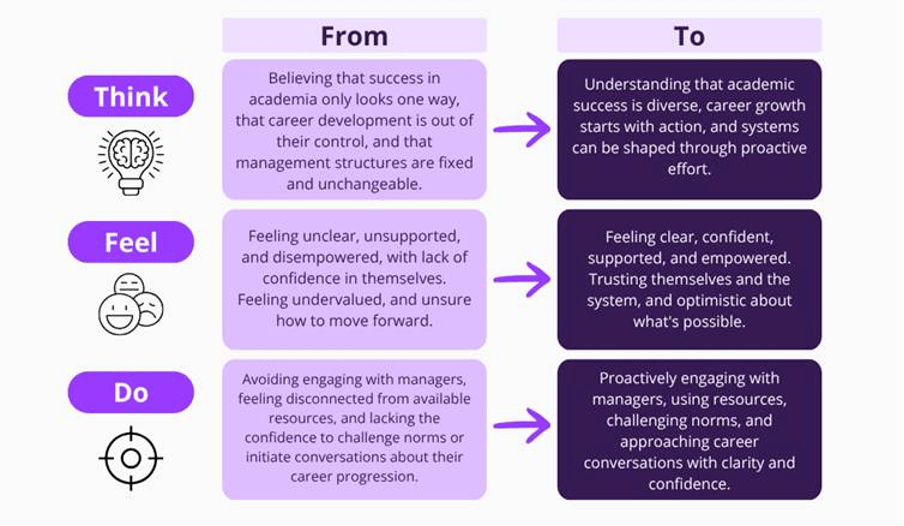
As part of the co-creation process, we asked our ECRs what they wanted to think, feel, and do differently when it came to their careers. A summary of the workshop responses is in the figure below. These insights became the foundation for the workshop design.
Enabling a ‘Growth Environment’
In response we created a space for ECRs to recognise their own agency, explore their aspirations, define career success and develop meaningful connections with peers.
The workshop was designed utilising the WHEN ‘growth environment’ methodology. These are the conditions WHEN create so all participants can do their best thinking and develop in a way that is proportionate to and appropriate to where they are and where they want to be. The methodology is deeply connected with the principles of time, equality of voice, and reflective depth, with the ambition to foster self-awareness. Researchers share their thinking as colleagues listen without interruption encouraging deeper reflection and increased self-awareness and discovery.
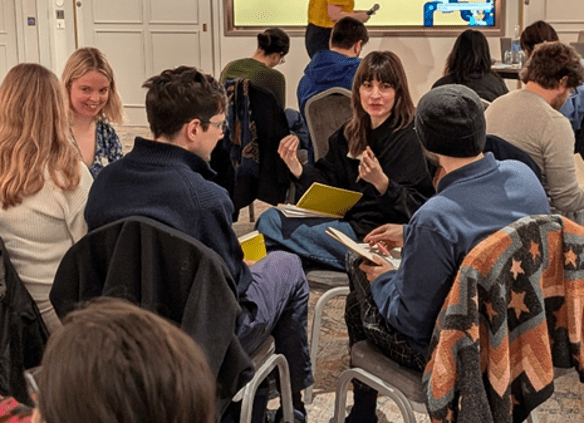
Delivered in-person, our workshop is structured around activities which encourage deep reflection and fearless dialogue, encouraging ECRs to take time away from their routine to deeply focus on their career planning.
The workshop has four objectives:
- Context – consider different career pathways and opportunities.
- Clarity – define what work you want to do.
- Choices – identify and articulate your career goals.
- Community – build meaningful and supportive connections.
In order to provide Context,we invited former ECRs from diverse career paths to share their experiences through a fast-paced Pecha Kucha format. Clarity was facilitated throughafuture-self visualisation activity todefine what career success, fulfilment and impact mean. This was highly personal and varied between individuals. For some participants, career success meant obtaining a promotion within academia, for others, it meant transitioning to a different sector, for others it was centred on achieving work-life balance. Choices were elucidated via apanel discussion with senior UCL colleagues and a guided activity to define participant development goals. We encouraged Community building through creation of peer-learning groups and providing additional networking opportunities throughout the day.
Measuring meaningful impact
The workshop was piloted in May 2025, with participants leaving more motivated, enthused, confident and less isolated. To date the workshop has been repeated twice more with consistently positive feedback underscoring its relevance and ability to spark real career progress. Six months on from the pilot, participants reported positive behaviour changes including exploration of new career pathways and opportunities, adapted or updated action plans, and regularly reflected on what is important to them in their career. This has led to exciting and tangible results, including the submission of promotion and grant applications, role shadowing, new connections with industry, and growth of internal and external networks.
One participant told us how the workshop directly motivated them to apply for and ultimately secure a fellowship.
“The workshop took place two days before a Policy fellowship deadline, and to be honest, before attending I had decided not to apply at all. The structured, step by step activities, particularly the way the process was broken down into manageable and realistic tasks, helped me focus, clarify my thinking, and feel that the application was genuinely achievable. As a direct result of the workshop, I did apply for the fellowship. I was subsequently shortlisted for interview and I am very pleased to say that I was offered the position… The workshop did not just offer encouragement in the abstract, but provided concrete tools that made a real difference at a critical moment – I am SO grateful!”
Ensuring continuous improvement
In response to feedback to further enhance the community building element of the workshop, we launched our ECR Career Aspiration Programme Ambassadors initiative. Alumni of the pilot workshop and researcher support professionals were invited to become small group facilitators in future workshops. Their purpose is to contribute to the growth environment by holding the reflective space so participants can maintain strong conversations. Not only does this method enrich the participants’ journey by sustaining their engagement with the programme, it also offers alumni a further developmental experience. This includes the chance to grow their transferable skills, such as facilitation, mentoring, and reflective leadership.
Our hope is that this model will amplify the workshop’s impact by sustaining momentum and strengthening long-term peer-support capacity, ultimately contributing to a more vibrant and connected research community.
Reflections from our Researcher Developer perspective
We believe that what makes our workshop different from the status quo and truly impactful, is the combination of its co-design and delivery, focus on researcher agency, and the distinctive growth environment methodology. Our workshop offers something rarely found in academic settings without purposeful intervention; protected time, the reflective depth needed for researchers to think clearly about their futures, and peer support. We believe this approach is critical if UCL is to continue to attract talented ECRs, achieve its research ambitions, and maintain its pipeline of excellence.


Leave a Reply