Dr Charmaine Lim* (LinkedIn; Staff Profile) University of Glasgow, UK and Lisa Backwell* (LinkedIn, Staff Profile) University of Edinburgh, UK.
Authors’ note: In keeping with the REDS 2026 Conference theme, we have taken a creative and playful approach to this blog. Drawing on data collected through submissions to a flexible funding call for research culture change, we reflect on what the concept of ‘collegiality’ can mean in practice and from different perspectives.
Collegiality: what is it?

[Charmaine] As somebody new to UK Higher Education (HE), collegiality seemed like such a foreign term. However, since working on the InFrame project (a multi-university research culture initiative funded by Wellcome), my understanding of collegiality has grown in unexpected ways:
- It’s not being ‘collegiate’ – contrary to popular misuse – which describes an organisational structure made up of colleges.
- Not to be confused with ‘congenial’ like Miss Congeniality, which means pleasant, or agreeable.
More than simply ‘agreeable’ collegiality began to look far more complex when we looked though a practice-based lens, as we seek to show here.
[Lisa] Collegiality can encompass many types of behaviours, and like many umbrella terms, makes it susceptible to many different forms of interpretation, which we can learn from. I’ve also seen it risk misinterpretation and even weaponisation, for example, through enabling overworking and poor workplace boundaries in colleagues, for fear of not being seen as ‘helpful’.
Within InFrame three closely-linked recognition projects (People Make Research; Seek, Find, Celebrate!; and Together, Research Excels) created an opportunity to characterise collegiality through examples drawing on lived experience. We hope using these examples will offer a clearer and more grounded framing for understanding what collegiality means, whilst also recognising how it drives positive research culture change.
Why collegiality?
Collegiality is increasingly being recognised as a key foundation of positive research cultures (Craig et al, 2025). It has been introduced as a criterion for academic professorial promotion processes (Dawson et al, 2022). However, there is a key gap in understanding of how colleagues (assessors, applicants) understand it and how evidence of collegiality is being used to assess promotion applications.
How did we seek to understand collegiality?
The InFrame project recognises this gap in the knowledge of collegiality and seeks to fill it, partly via the implementation of a flexible funding call, the Research Culture Catalyst Fund, led by the University of St Andrews. This funding call invited new projects focused on leadership and collegiality. While we did not specifically or explicitly define collegiality in the guidance material, we did state in communications and pre-award support, that we were seeking to fund projects related to ‘collegial research leadership’. We also used collegiality (Cipriano and Buller, 2012; Brown, 2021; Guccione et al, 2026) as the lens to analyse the content of the funding applications as a way to chracterise how the term is understood and applied in practice. Collegiality is not easy to define (Woodfield, 2025) and so we wanted to make our analysis meaningful across the different aspects of research ecosystem, not only to scholars. To keep our analysis practical and community-driven, we used participants’ own words to broaden our understandings of collegiality. Below the major themes arising in the submitted projects are shown in Figure 1, and discussed below.
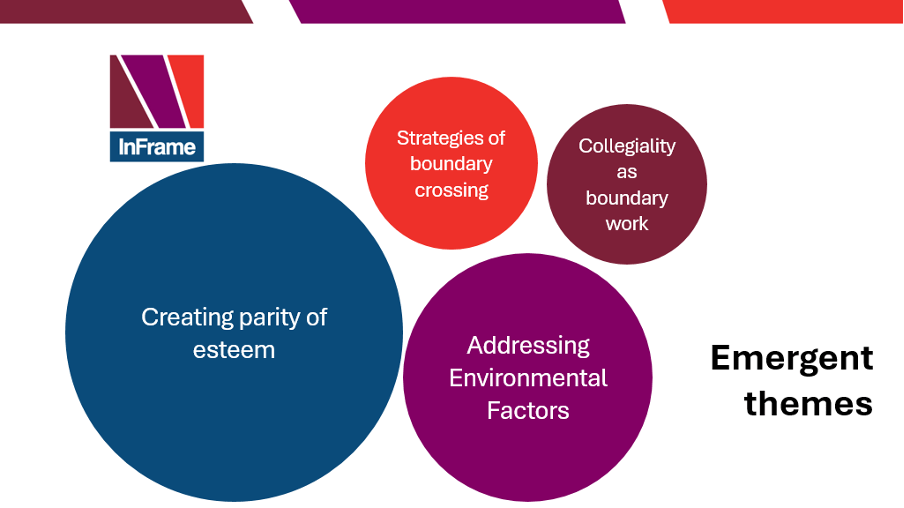
Creating parity of esteem
In agreement with scholarly understandings of collegiality as being an act of respect, it’s perhaps no surprise that ‘parity of esteem’ emerged noticeably as a major theme. Many of the projects sought to acknowledged raise awareness of the vital contribution of often overlooked groups within their research communities. The activities they proposed in the applications sought to enhance career development and progression for their peers or colleagues often alongside greater recognition of their role in research.
Addressing environmental factors
Project ideas also looked to improve certain environmental factors to address underrepresentation and enhance inclusion and accessibility within research for different communities, such as women researchers, researchers navigating specific life stages, disabled researchers, neurodiverse leaders, community partners, or Research Technical Professionals (RTPs). These funding applications revealed and highlighted the features of an inclusive research environment and ideas about how to address these issues of underrepresentation through pilot initiatives or scaling of existing activities.
Strategies of boundary crossing and collegiality as boundary work
The remaining key themes both related to the types and direction of relationship(s) when considering an extension of collegiality as being something that takes place only within departments (Cipriano and Buller, 2012). What we saw were projects that sought to establish or build relationships and collaborations that went beyond the institution, as well as within the institution. Taken together, these themes revealed two insights:
- The institution as one that is ‘closed’. That may seem obvious to us all who are situated within institutions, but what it revealed were these boundaries appeared to be multifarious: discipline-specific, location-based, ideologically driven, and related to job role, and identities.
- Many projects recognised, acknowledged or cited the outcome of ‘collegiality-as-practice’ (an enacted interpersonal practice) that had the potential to cross those identified perceived boundaries and increase belonging (after Langley et al, 2019; Ortner, 2006; Yuval-Davis, 2011). Project Leaders applying for the funding sought to engage those outside the department or communities via public engagement, policy work, patient-public involvement – as a collegial duty. Much of this work was seen as invisible labour, performed in addition to job roles.
Our analysis thus suggests an additional dimension to collegiality work, which is about achieving or navigating the politics of belonging within UK HE.
Insights and call to (reflective) action
Our insights align with existing literature on collegiality and extend to consider the politics of belonging within HE (specifically UK HE), suggesting that collegiality has a much broader scope and is a matter of increased belonging – the two intrinsically linked. They reveal the interplay between structure and agency, in that aspirational and purposeful collegiality expands the possibilities that traditional notions of collegiality offer, while at the same time not discounting the structures that are already in place and the constraints of research environments.
Much of the literature on belonging in HE has talked about the issue from context or perspective of students (Allen et al, 2024; Graham and Moir, 2022), postgraduate researchers and doctoral schools (Strathclyde Doctoral School; Hainsworth, 2023) and early career researchers (Naseem, 2023; InFrame Symposium 2026). What our analysis suggests is that collegiality and belonging go hand in glove and in a way reinforce one another. As in Jones and Bell, 2025 where the authors found that ‘connections, caring and mattering’ were important factors for improving belonging among university staff and students. Thematic analysis of data from InFrame’s recognition projects yielded similar findings (see Lim, 2026), in particular among those across the research ecosystems at a multi-institutional context and complements existing findings that suggest importance of considering solidarity even for purposes of maintaining and/or regulating research integrity (Horbach et al, 2023).
We would like to finish with a call to reflection:
- How has this presentation and exploration of our findings shaped your understanding of collegiality?
- What other types of ‘collegiality as practice’ can you name?
- How would you implement your policies and processes to encourage collegiality and belonging?
* The authors contributed equally to this work.
The authors would like to thank the reviewers for improving an earlier version of the draft. This post was edited for brevity and clarity with the aid of Microsoft CoPilot.


Leave a Reply