Marion Gürth (ORCiD), and Dr. Barbara Janssens (ORCiD), DKFZ German Cancer Research Center, Heidelberg, Germany
Project management (PM) skills are increasingly valued by employers of Early Career Researchers (ECRs), therefore training in PM is highly relevant. In PM training courses, ECRs can earn certificates, and learn the vocabulary and frameworks. What many still lack, however, is the opportunity to apply this knowledge in real settings: to lead a team, navigate ambiguity, and generate credible evidence of their skills for current team-based work and future employers.
Meanwhile, institutions and (post)graduate programs need to organize events (career days, retreats, symposia…), often also driven by ECRs themselves. The PM Studio – a long-running and low-cost initiative of the Career Service at the German Cancer Research Center (DKFZ, here on LinkedIn), Germany’s largest biomedical research institute – was designed to close exactly this gap. Here we describe the model and how it can be implemented at other institutes.
What is the PM Studio?
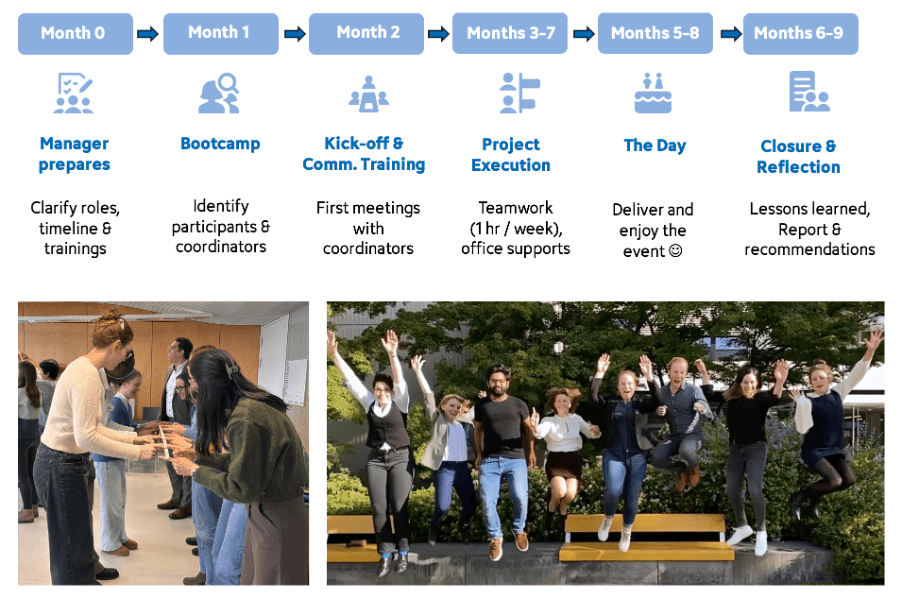
The PM Studio concept follows a ‘sandbox’ approach to learning (a safe, low-stakes practice space to learn new skills), is exemplified to be extremely useful for doctoral researchers (Sharp and Marchetti, 2020): a supported space in which participants practise essential PM and leadership skills by organising a Career Day under realistic conditions, with the safety net of experienced research managers (see this short video on the experiences of the 2021 cohort). Participants are not running a simulation, they are responsible for real deliverables, real stakeholders, and real consequences. Professional trainers (in our case ‘Beyond Science’ Tilo Senger and Daniel Gau) accompany the bootcamp, kick-off and lessons learned (Figure 1), offering PM and team collaboration training, leadership coaching for team coordinators, and a facultative ‘PM in Action’ day. Teams work through the full project life cycle – from initiation through delivery to formal closure and reflection, using Gantt charts, Kanban boards, RACI and risk matrices, stakeholder mapping, and communications and marketing planning. They use these tools that are useful for research projects (Mewburn et al., 2026) within a low risk ‘sandbox’. Along the way, they encounter challenges that are familiar to anyone who has worked on projects.
Misunderstandings and small conflicts as growth opportunities
At the bootcamp participants do team exercises like ‘lower the stick’ to get a first taste of what collaboration is like (Figure 2, below). However in PM, teams tend to learn more from friction than from smooth collaboration. The most common sources are unclear ownership, differing definitions of ’done’, and mismatched expectations around speed, quality, or authority, precisely what forces teams to develop real judgment. This learning accelerates under delivery pressure, where competing priorities or incomplete information demand real decisions. When the pressure is on, theory gives way to experience. What classroom learnings give is vocabulary; what misunderstandings teach is when to ask for clarification, how much detail is enough, and who needs to be in the room and at what point.
Ten years of evidence
Over more than ten years, the PM Studio has run 27 cohorts with more than 160 ECR organisers. Across cohorts, 90% of participants report increased confidence in planning and undertaking project work. But the impact reaches beyond skills: participants consistently describe the experience as a turning point in their professional self-awareness (Salm & McKinney, 2024).
”Being part of an organising team and especially the reflection afterwards boosted my confidence. I went from “I like organizing things” to “I can give concrete examples of proactively adding value to projects”.
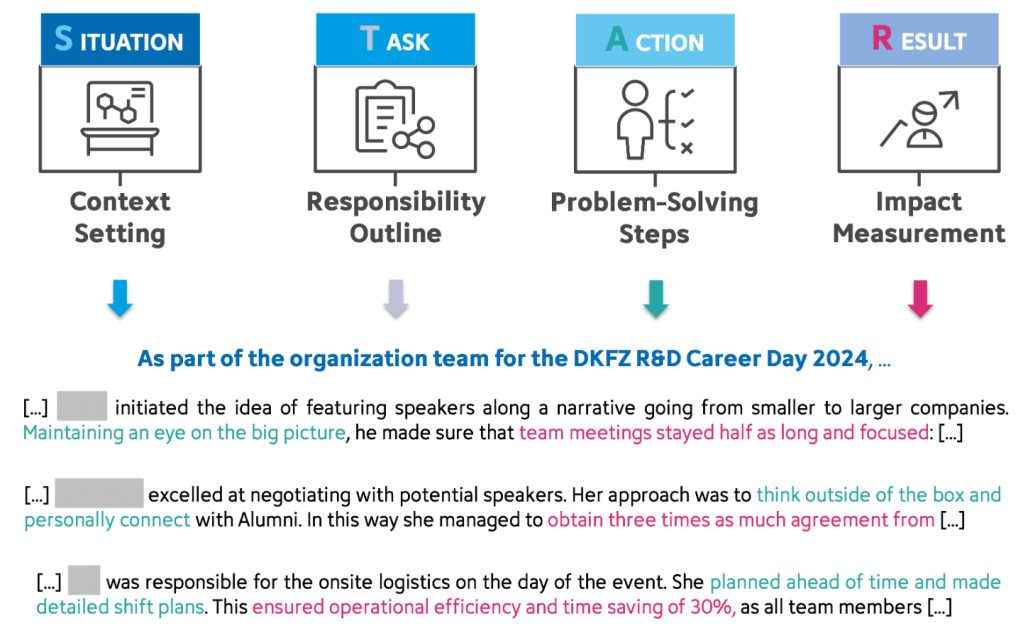
How to researchers become aware of the PM skills they gained? If they would like to get a LinkedIn recommendation, they have to reflect on their learning using the STAR method to turn experience into compelling, evidence-based examples of specific contributions. This is an integral part of our career planning tool CareerCheck. For ECRs, building their professional profile this is particularly powerful. It transforms participation into something concrete and portable, credible, third-party proof of PM experience that can speak for itself in a job interview (Figure 2). For several participants, the PM Studio becomes a stepping stone into professional roles in research management, administration, consulting, or industry. For others, it provides the equally valuable insight that PM is not their long-term path, career clarity that is as useful as career confirmation.
The organiser gains too
The PM Studio is not purely altruistic, there are real benefits for research managers overseeing the event. First, event quality improves. ECRs organising for their peers understand the audience. They know what makes a networking session feel contrived and what makes it genuinely useful. That proximity translates into a more relevant, more engaging programme.
Second, the role of research managers shifts. Rather than executing tasks, we move into mentoring and coaching, working alongside teams through real decisions, and supporting their development. This is meaningful work and frees capacity for the deeper career conversations that are harder to scale.
Third, and perhaps most surprisingly, the team consistently outperforms us in marketing the event. Motivated ECRs approaching companies as peers, bring an authenticity and energy that a manager cannot replicate, with more time, motivation, and credibility with potential speakers and sponsors. The result: better-resourced and better-attended events.
Could this work at your institution?
The PM Studio model is transferable. Any institution that runs events aimed at ECRs, such as career days, ECR-led conferences/symposia, retreats, or fairs, has a natural scaffold on which to build something similar. The key ingredients are a real event, a cohort of willing participants, and a support structure that gives them genuine responsibility alongside guidance.
We warmly invite researcher developers, career professionals, and ECRs organizing events to get in touch. A step-by-step how-to guide and supporting materials are available on request. Whether you want to explore the concept, trial the model, or simply exchange experience, we would love to hear from you. Contact us via our DKFZ Careers & Alumni Relations Service LinkedIn page or careers@dkfz.de.
–
Note on AI use: Claude (Anthropic) assisted with the linguistic and stylistic editing of this text. All content was critically reviewed and reflects solely the authors’ own work and judgement. Thanks to the REDs reviewers and Ana Salgado for helpful comments.


Leave a Reply