By Sally Shirran, Mass Spectrometry Facility, School of Biology, University of St. Andrews, UK; Susie Cook, Department of Sustainability and Social Responsibility, University of Edinburgh, UK; Lee Murphy, Edinburgh Clinical Research Facility, School of Neurological and Cardiovascular Sciences, University of Edinburgh, UK; Claire Spangler, Edinburgh Research Office, University of Edinburgh, UK; Phil Whitfield, Medicine Veterinary and Life Sciences, University of Glasgow, UK; Claire Wilson, College of Science and Engineering, University of Glasgow, UK; andNatalie ZM Homer Senior Research Fellow, Edinburgh Clinical Research Facility, School of Neurological and Cardiovascular Sciences, University of Edinburgh, UK.
A core facility is a specialised, centralized shared resource within a research institution. They typically include specialised technologies and importantly, experts to run them. Ideally, they offer researchers at all career stages easy, equitable access to cutting-edge technologies and expertise for conducting research. Crucial to the success of core facilities are the research technical professionals (RTPs), whose expertise and knowledge make this possible. From core facility leads to data scientists and instrumentation specialists they design, run and improve the platforms that enable scientific discovery. Their expertise and knowledge make this possible. Despite their essential contributions, the roles and voices of RTPs are often hidden. Compared with their academic peers, RTPs typically lack career pathways and face a patchwork of professional development opportunities and mentorship. This disparity highlights a crucial area for improvement in recognising and advancing the careers of these key contributors to research and education in the academic and scientific community.
The Recognising Leadership and Expertise (RELAX) in Technical Specialists project is our response to these challenges, with a particular focus on those leading core facilities. This blog post explains why recognising RTPs matters for research quality, culture and sustainability of core facilities.
The Technician Commitment
Since 2017 and the establishment of the Science Council and Gatsby Foundation Technician Commitment, spear-headed by Kelly Vere, much effort has gone into raising the profile of technical roles in higher education. Currently 117 institutions have signed this commitment which asks for action plans, committee oversight and periodic peer-reviewed self-assessments. Greater recent emphasis on ‘research culture’ has led to some institutions embedding the Technician Commitment into their research culture development aims, while reports and sector updates keep the initiative in view.
In 2014 BBSRC identified vulnerable capabilities and skills within the UK bioscience and biomedical research base. By surveying more than 800 technicians and laboratory assistants about their roles, careers and professional recognition they highlighted a blurring between technical and academic roles and lack of a career path for technical careers (Ball, Hardwick and Vere, 2016). This set the groundwork for the landmark 2022 TALENT commission report including 16 recommendations to technical staff, line managers, higher education institutions and the funding bodies. The Technician Commitment action plan published by UKRI in 2021 has also noted the need for specific action in this area noting that RTPs are vital for the operation of research infrastructure.
Why RTP leadership matters
We operate major instruments, develop methods, teach students, we lead large scale facilities, train researchers and implement mid and large-scale capital investments that deliver impact. Leadership in our specialisms, and as part of research teams is a core part of that.
The 2022 Research Culture: A Technician Lens and the 2024 Strategic Technical Leadership report highlighted a further pivotal role strategic technical leaders can play in developing institutional strategy. These reports advocate and recommend inclusion of RTPs in decision-making committees, while also highlighting the value of developing and engaging in external professional networks. Further,UKRI now encourage RTPs to lead and co-lead on research grants and join grant panels.
Yet the TALENT report Research Culture: A Technician Lens (2022) highlighted specific challenges to being seen as leaders, including visibility, authorship credit, workload and career pathways. We set out to address this.
Building an RTP-led network of Core Facility Leads in Scotland
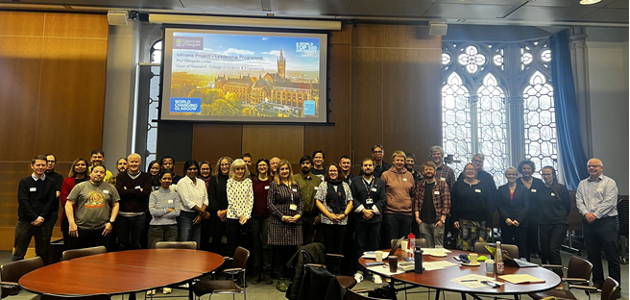
With Wellcome’s InFrame project Culture Catalyst funding, we brought together a network of 36 RTPs in November 2025, centred on leaders of core facilities from Edinburgh, Glasgow and St Andrews universities. In partnership with ITSS Consulting we developed a leadership course to empower RTP leaders, recognise leadership potential, expand RTP’s sphere of influence and contribute to institutional and cross-institutional goals with greater strategic confidence. The course had three in-person sessions over a 5-month period, with opportunity to meet senior leaders, interspersed with virtual sessions, discussing issues such as authorship, sustainability and equipment sharing, expanded on below:
Policies for recognition and authorship: from principles to practice
Guidance on authorship for publications from the Association of Biomolecular Resource Facilities and EMBO reports and the Royal Microscopical Society core facilities publication policy make clear that core facility staff and other RTPs should be acknowledged in publications that uses data they have generated or co-authorship when contributions include experimental design, method development or advanced analysis. They can also play a role in ensuring FAIR data principles are followed. Detailed methods for transparency and rigour, alongside reliably generated curated data ensures research integrity is upheld. We compared policies for FAIR attribution across the 3 universities and find differences in wording and visibility of these policies. Guidelines are valuable but with room for interpretation and no mechanism for checking, then RTPs are still missing recognition and authorship. Without recognition the roles remain hidden and in the current higher education climate that introduces vulnerability and a lack of demonstrable impact. Where co-authorship is forgotten, reproducible methods are in question, which affects research integrity. To recognise expertise and for improved research culture fair attribution on outputs needs reviewing and assessment within departments and universities.
Sustainability, equipment sharing and the Environmental Concordat
In 2024, the Universities of Edinburgh, Glasgow and St. Andrews all signed the Concordat for the Environmental Sustainability of Research and Innovation Practice. As a signatory each university commits to embed sustainability across its research practices; a key area where core facility leads and RTPs contribute. By definition core facilities positively contribute to environmental sustainability through efficient, expertly supported sharing of high value equipment. We hope that conversations started though our leadership course will bring into focus the role that these core facility leads play in institutional equipment sharing and sustainable policies.
Making equipment findable and affordable for equity of access for researchers
Scotland has world class core facilities, infrastructure and research capabilities, but it is not always easy for researchers to find or access the technologies and the expertise. The JISC equipment data service is an answer, but it needs wider engagement from funders, facilities and researchers. Other national portals exist, including the ITSS Facilities Showcase. Our RELAX cohort connects the three universities and it opened conversations on the benefits and challenges of equipment sharing. Institutionally criticism of equipment sharing is often because items are not ‘findable’. We began with the idea of building a regional equipment list. However, through discussions with the RELAX cohort we realised we had lost sight of the expertise that enables the equipment’s capabilities. Reminded that it is the expertise of RTPs in core facilities that is important, the RELAX project is instead developing a Directory of Expertise of the core facility leads to raise visibility and provide a searchable platform to highlight the skills of RTPs on an outward-facing website.
A culture change for greater research impact
UKRI mapped research culture initiatives in their 2024 report ‘Research culture initiatives in the UK’, which acknowledges that progress and a change of research culture depend on shared frameworks, evaluation and co-production within communities that do the work.
RELAX is RTP-led and co-created as part of the InFrame Culture Catalyst project. We are at the coal face of technology implementation, infrastructure management and research delivery. We hope that raising awareness of the existing skills and research leadership through the Directory of Expertise, active discussion of sustainability of facilities, assessing fair attribution policies, discussing engagement with industry and meeting with senior leaders has encouraged the RELAX cohort to step forward and make positive change to systems in their institutions.
Given their substantial contributions to research leadership, education, methodological innovation, technological development and commercial engagement, RPT career progression to professorial levels should be an achievable and recognised pathway for outstanding core facility leads. Institutions must work proactively to ensure that such progression is no longer the exception.


Leave a Reply