Dr Molly Jameson (ORCiD), Academic Developer, University of Strathclyde, UK.
When we think about researcher development, we often think about doctoral researchers, postdoctoral researchers, research staff, or academics developing their disciplinary research skills. Less frequently do we consider how investigating our own educational practice can contribute to the development of research capability and identity. Yet this is precisely the opportunity offered by the Scholarship of Teaching and Learning (SoTL).
The argument of this article is simple: the Scholarship of Teaching and Learning is not only a means of improving education but is also a powerful and often overlooked pathway for researcher development. Through systematic inquiry into teaching and learning, educators engage in many of the same practices that underpin research itself, developing skills, confidence, scholarly networks, dissemination experience, and ultimately research impact.
This article draws on the author’s experience supporting SoTL projects across academic development initiatives at the University of Strathclyde alongside relevant literature relating to researcher development and academic identity.
What is the ‘Scholarship of Teaching and Learning’?
For readers whose work sits primarily within research culture, researcher development, or higher education policy, the term ‘Scholarship of Teaching and Learning’ may be unfamiliar. The Scholarship of Teaching and Learning, often referred to as ‘SoTL’, emerged from Boyer’s (1990) influential work Scholarship Reconsidered, which argued that universities should recognise multiple forms of scholarship, including the scholarship of teaching. Building on this foundation, Shulman (1998) suggested that scholarly work becomes scholarship when it is made public, subjected to peer review, and shared in ways that allow others to build upon it.
In practice, SoTL involves systematically investigating questions about student learning, curriculum, assessment, feedback, or educational practice using appropriate methods and evidence. Importantly, it extends beyond the concept of reflective teaching. Reflection becomes scholarship when it is informed by existing literature, undertaken systematically, critically analysed, and shared publicly with peers.
As such, the Scholarship of Teaching and Learning can be understood as a form of practitioner research situated within higher education. It asks educators to approach questions arising from practice with the same curiosity, rigour, and transparency that they would bring to disciplinary research.
Starting with authentic questions
One reason the Scholarship of Teaching and Learning can be such an effective route into research is that it begins with questions that genuinely matter to practitioners. In my work as an Academic Developer at the University of Strathclyde, conversations rarely begin with colleagues expressing a desire to become educational researchers. More often, they are wrestling with practical challenges:
- Why are students struggling with a particular assessment?
- How can feedback support deeper learning?
- Why do some learners engage enthusiastically while others do not?
- What effect has a curriculum change had on student experience?
These are educational questions, but they are also research questions.
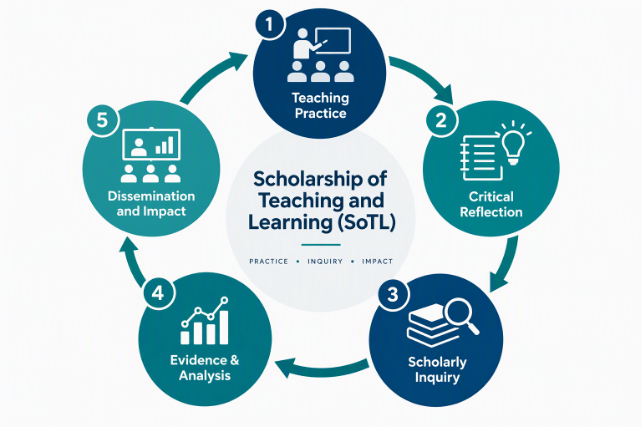
What distinguishes scholarly inquiry from routine reflection is the decision to investigate those questions systematically. This typically involves reviewing relevant literature, identifying suitable methods, gathering evidence, analysing findings, and sharing outcomes with others (as depicted in the graphic below). At this point, a teaching question becomes a research project.
Learning to be a researcher through inquiry
Researcher development is often framed around the acquisition of skills: designing studies, analysing data, engaging with literature, disseminating findings, and contributing to scholarly communities (Vitae, 2020). The Scholarship of Teaching and Learning requires exactly these capabilities.
When colleagues investigate their educational practice, they formulate research questions, undertake literature reviews, navigate ethical considerations, collect qualitative or quantitative data, analyse evidence, and communicate findings. These activities mirror many of the competencies associated with researcher development frameworks.
For some staff, particularly those who have stepped away from research activity or who have not previously engaged with educational inquiry, SoTL provides an accessible entry point into research. The context is familiar. The questions are meaningful. The potential for impact is immediate.
Importantly, success can build confidence. One example from my own practice involved a colleague who wanted to improve the speed with which students received feedback. Beginning with a practical concern rather than an intention to undertake research, they introduced a 60-second feedback approach and evaluated its implementation. When the colleague approached me for advice about publication, we discussed Beckingham’s concept of the SoTL Staircase, which emphasises developmental progression through different forms of dissemination and scholarly engagement. Rather than moving immediately to publication, they presented their work at the University’s Learning and Teaching Conference. The project has since progressed further and is now being shared with a wider sector audience through an Advance HE conference presentation. What began as a local teaching question evolved into scholarly dissemination, growing confidence, and engagement with a broader community of practice.
I have observed colleagues who initially view themselves solely as teachers begin to identify as researchers through the process of conducting SoTL projects. Presenting at conferences, writing blogs, submitting funding bids, publishing papers, and contributing to institutional discussions all help strengthen a sense of scholarly identity.
Academic identities are increasingly understood as dynamic and socially constructed, emerging through engagement with academic work and practice rather than fixed institutional categories (Clegg, 2008). Similarly, as Brew (2006) argues, becoming a researcher involves more than acquiring technical skills; it requires developing a research identity through active participation in scholarly inquiry and knowledge creation. If SoTL develops questioning, literature engagement, data analysis, dissemination and impact, then SoTL actively cultivates researcher-development capabilities.
From local evidence to wider impact
A common criticism of SoTL is that projects are often context-specific. A study conducted within one programme, discipline, or institution may not generate universally applicable findings. Yet this criticism arguably misunderstands the nature of impact.
Many forms of higher education research begin with local questions. The value lies not in claiming universal truths, but in generating evidence that others can interpret, adapt, and apply within their own contexts. High-quality Scholarship of Teaching and Learning makes its context visible. It explains what was done, why decisions were made, what evidence was gathered, and what conclusions were reached (Felten, 2013). This transparency enables readers to determine relevance for their own settings.
Importantly, impact often emerges through a series of connected developments rather than a single publication or intervention. In the example described earlier, a colleague’s initial question concerned providing feedback to students more quickly. What began as a local enhancement activity evolved into conference presentations, engagement with a wider scholarly community, and increasing confidence as a SoTL researcher. The project influenced practice locally, contributed to professional development, and ultimately reached a sector-wide audience.
This highlights an important point for researcher development. The impact of the Scholarship of Teaching and Learning is not limited to improved student learning, although that remains important. It can also generate impact on the educator, developing research confidence, scholarly identity, and dissemination capability. In turn, these developments can contribute to wider conversations about educational practice both within and beyond an institution.
Seen in this way, the Scholarship of Teaching and Learning creates multiple forms of impact simultaneously: impact on students through enhanced learning experiences, impact on educators through researcher development, and impact on the sector through the dissemination of evidence-informed practice. The result is a shift from practice enhancement to knowledge creation.
Implications for researcher development
If we accept that the Scholarship of Teaching and Learning can function as researcher development, institutions should think carefully about how it is supported and recognised.
Too often, educational inquiry is positioned as something separate from ‘real research’. Yet the boundaries are increasingly difficult to justify. The skills developed through educational inquiry are transferable across multiple forms of scholarship, while the outputs generated contribute to institutional knowledge, educational quality, and broader sector conversations.
Academic Development teams are particularly well placed to support this work. By helping colleagues transform everyday questions into systematic investigations, they create opportunities for staff to engage in authentic research activity.
Effective support may include:
- creating opportunities to identify and refine researchable questions;
- developing capability in research design and evaluation;
- supporting ethical and methodological decision making;
- building communities of inquiry and peer review;
- creating routes for dissemination and publication; and
- recognising educational scholarship as a legitimate research contribution.
These activities align closely with broader ambitions around research culture: creating environments in which inquiry, reflection, collaboration, and knowledge sharing are valued.
Why this matters now
Higher education institutions are increasingly concerned with research culture, impact, professional development, and evidence-informed decision making. The Scholarship of Teaching and Learning sits at the intersection of all four.
My experience at Strathclyde has convinced me that some of the most important researcher development opportunities begin not in laboratories, libraries, or grant applications, but in classrooms, assessment discussions, and conversations about learning.
When educators systematically investigate their practice, they do more than improve teaching. They learn how to formulate questions, evaluate evidence, critique assumptions, communicate findings, and contribute to scholarly debates.
In short, they develop as researchers.
Perhaps, then, we should stop viewing the Scholarship of Teaching and Learning solely as a mechanism for educational enhancement. Instead, we might recognise it as a valuable and often underappreciated pathway through which researchers are developed, research identities are strengthened, and scholarly impact is created.
Generative AI statement: Microsoft Copilot was used to support the structure of this article and the refinement of the graphic. The ideas, interpretations, examples, and final text are the author’s own work.


Leave a Reply