By Dr Tania Maria Villanueva Cabello (ORCiD), Postdoctoral Fellow, Institute for Advance Teaching and Learning, University of Warwick, UK. Professor Elena Riva (ORCiD), Principal Investigator, Institute for Advance Teaching and Learning, University of Warwick, UK. Virginia Thomas-Pickles, PhD Student, Institute for Global Sustainable Development, University of Warwick, UK.
The early career researcher (ECR) stage (here defined as encompassing doctoral students and postdoctoral researchers) is a critical period for wellbeing. ECRs drive innovation and sustain academic communities, yet they do so within structures that can systematically undermine their wellbeing. High rates of anxiety, depression, and burnout are well-documented across this group (Wellcome Trust, 2020), and the evidence suggests these are not individual failings but structural ones.
Why wellbeing literacy, and why now?
Wellbeing literacy refers to the knowledge, language, and skills that enable people to understand and actively tend to their own wellbeing (Oades et al., 2021). It has increasingly been applied as a framework for supporting wellbeing in higher education settings (Riva et al., 2024). In the ECR context, it could offer a proactive rather than reactive approach: rather than waiting for difficulty to arise, it could equip researchers with the tools to recognise pressures early and respond accordingly.
The case for this kind of intervention is clear. Doctoral students report higher levels of mental distress than contracted research staff, alongside greater difficulty managing emotions and sustaining motivation toward long-term goals (Cilli et al., 2023). For postdoctoral researchers, around 40% across nine Dutch universities reported serious mental health difficulties linked to precarious contracts, unclear career prospects, and limited institutional support though supervisor and peer encouragement offered meaningful protection (van der Weijden & Teelken, 2023). Structural autonomy, having control over working methods and boundaries has also been shown to significantly reduce anxiety and depression among postdocs (Lo et al., 2024).
Additionally, the current evidence points to a need for comprehensive, multi-level responses that address individual, interpersonal, institutional, and systemic dimensions of ECR wellbeing (Mahsood et al., 2025). Wellbeing literacy is one part of that response and, importantly, it is one that institutions can act on. Our aim was to develop a wellbeing literacy provision that would genuinely meet ECRs’ needs not by deciding on their behalf what those needs were, but by involving them directly in shaping it.
Starting with listening
As part of the Enhancing Research Culture Funding-Building Wellbeing Literacy: Co-creating opportunities for doctoral and postdoctoral researchers project, we began by asking ECRs what their research challenges looked like rather than mapping existing frameworks onto ECR experiences.
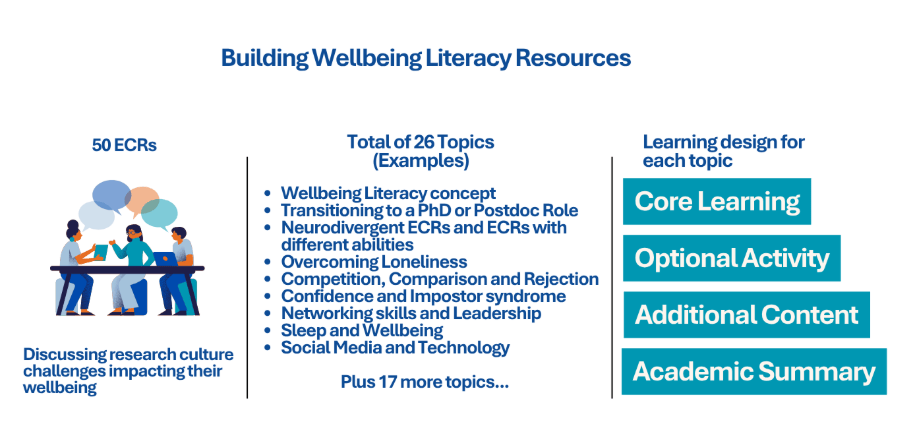
Fifty ECRs at Warwick – 30 doctoral students and 20 postdoctoral researchers – from across faculties and disciplines participated in listening workshops designed to surface the real pressures shaping their research experiences. A further 19 participants contributed to an iterative feedback phase to test and refine early resource designs in the listening feedback workshops.
Participants discussed what wellbeing meant to them, the challenges they encountered throughout their research journeys, and what kinds of learning formats would realistically fit into their demanding academic schedules. Qualitative data were analysed using reflexive thematic analysis (Braun & Clarke, 2006), generating themes across foundational wellbeing concepts, role-specific milestones, workplace environments, and life outside research.
Twenty-six distinct challenges emerged. Some were role-specific with doctoral students frequently raised difficult supervisor dynamics, while postdocs more often described challenges in establishing productive working relationships with their principal investigators. But most challenges were shared. Competition, comparison and rejection, loneliness, the pressures on international researchers, neurodivergent ECRs, disability, and a pervasive cultural reluctance to celebrate small wins all featured prominently.
Precarious employment was a particularly sharp theme for postdoctoral researchers:
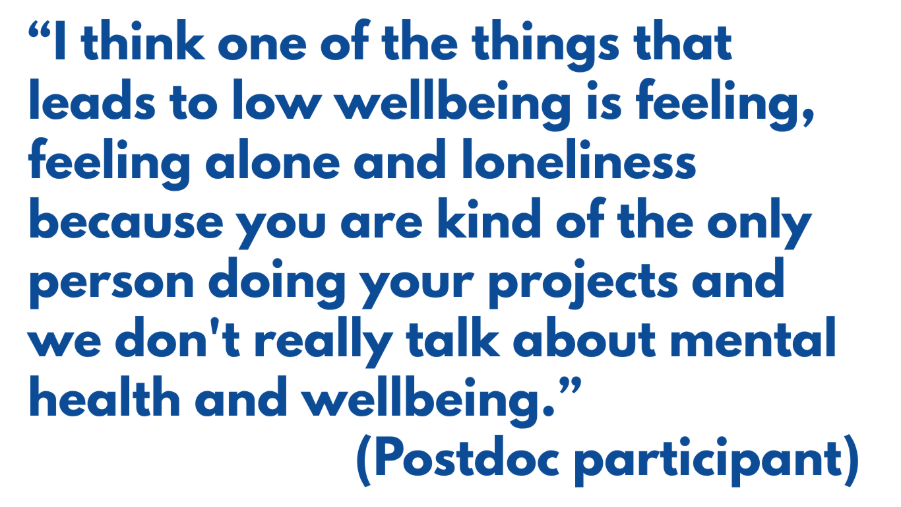
“The fact that we are all on time-defined contracts and [there’s] constant sort of [worry] above your head—what are you going to do after—while balancing the science experiments, the everything else, the mentoring of students, everything.” (Postdoc participant)
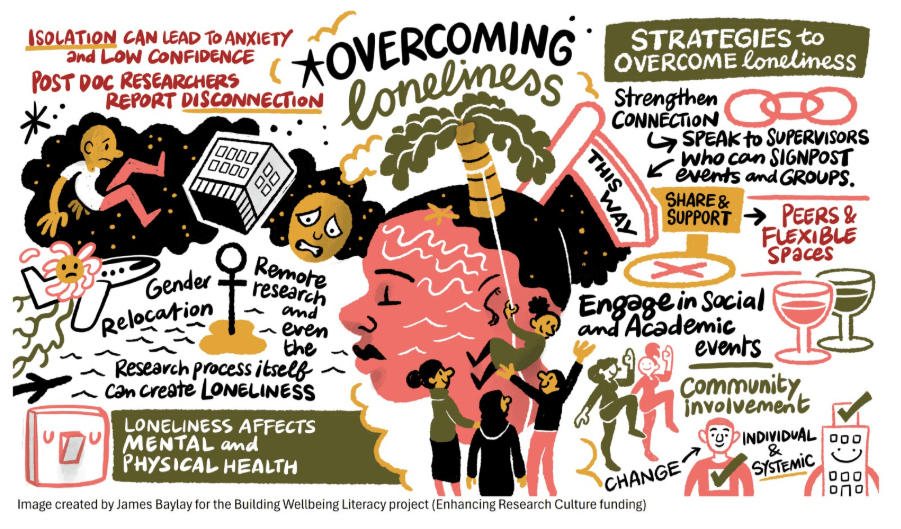
And besides shared physical workspaces, isolation surfaced repeatedly. ECRs described feeling professionally alone even within active research communities a reminder that proximity is not the same as connection.
From listening ECRs to creating resources
Each of the 26 challenges was developed into a dedicated learning topic grounded in academic literature. Participants shaped not only the content but the format. Given the time pressures ECRs face, every topic follows a standardised four-part design:
- Core learning: evidence-based exploration of why a challenge affects wellbeing, delivered through participant-chosen formats including expert videos, podcasts, animations, infographics, and written content
- Optional activity: reflective exercises or quizzes for deeper personal engagement
- Additional content: curated external resources for those who want to go further
- Academic summary: a full reference list for those who want to explore the underpinning research
The resources were built in Articulate Rise 360 by the Flexible Online Learning Division (Warwick) and embedded within Warwick’s Moodle platform, making them accessible to all ECRs regardless of department or career stage.
What we learned and what others might do with it
The most significant finding from this project is not what ECRs struggle with much of that is already documented but what they said they needed to engage meaningfully with support. We observed that ECRs are really interested in their wellbeing and had clear views on format, length, framing, and tone. They wanted resources that took their research interest and time constraints seriously, that were grounded in evidence, and that addressed structural pressures rather than relocating responsibility entirely onto individual researchers.
We highlight that our co-participatory approach also models a form of engagement; experience-led learning that resonates with how researchers already think and work. By co-creating and involving the ECRs in the process they reflected and questioned their experiences but also their wellbeing needs.
Limitations
There are also honest limits to acknowledge. These resources address individual and interpersonal dimensions of wellbeing; they cannot resolve precarious contracts, excessive workloads, or deeply competitive institutional cultures. Wellbeing literacy works best as part of a broader institutional commitment to structural change not as a substitute for it. Yet, wellbeing literacy could support ECRs wellbeing during this crucial stage to prepare for future challenges.


Leave a Reply