By Judit Kovacs, PhD Researcher, Wolfson Institute of Population Health, Emma Hayashibara, PhD Researcher, School of Biological and Behavioural Sciences, and Melanie Crisfield, Centre for Early Career Researchers, all at Queen Mary University of London, UK.
Postgraduate researcher (PGR) development does more than equip PGRs with skills and practical knowledge. It also introduces the norms, values and expectations of academia, including what constitutes as expertise and ‘good’ research, how research should be communicated and disseminated, and what we consider meaningful impact.
However, it is important to recognise that these assumptions are not neutral. Academic institutions and practices have historically been shaped by Western and Eurocentric traditions, privileging particular forms of knowledge while marginalising others, such as Indigenous peoples and those from the Global South (Dei, 2016; Denscombe, 2025). In this context, we understand decolonisation as an ongoing process of critically examining whose knowledge, experiences, perspectives and ways of working are centred within academic institutions. A decolonial approach challenges the dominance of Eurocentric ways of knowing and creates greater space for knowledge, perspectives and practices that have historically been marginalised (Dei, 2016).
As universities seek to create more inclusive research ecosystems, there has been growing attention to decolonising education and research methodologies (Ndlovu-Gatsheni, 2017; Wright, 2022). While existing resources aim to decolonise subject-specific curricula, research methodologies and the doctorate as a whole (e.g., Denscombe, 2025; Wright, 2022), less attention has focused specifically on PGR development programmes. We believe this matters: if we are striving towards a more inclusive academic ecosystem, we also need to critically examine and improve the training environments through which PGRs develop their understanding of how research is practised. As such, PGR development must recognise the diverse backgrounds of researchers, the multicultural societies within which universities are situated, and the culturally complex and sensitive questions that researchers may encounter through their work.
Moving from theory to practice at our University
At Queen Mary University of London (QM), we are therefore exploring how to apply a decolonial lens to postgraduate researcher development, moving beyond teaching about decoloniality towards embedding decolonial principles within the design and delivery of PGR training itself. As such, we aimed to develop a practical resource that could support this process, and developed a set of principles, that include reflexive questions and practical recommendations, for embedding decolonial and reflexive approaches within PGR development activities hosted by the University.
The development process was led by our small team consisting of the Researcher Development Advisor (PGR) for QM’s Centre for Early Career Researchers and two QM PGRs. The process started with familiarising ourselves with existing work on decolonising the curriculum through completing a course by the University of Bristol ‘Decolonising Education: From Theory to Practice’ (University of Bristol, n.d.). We then conducted an initial review of existing CECR PGR training materials, from which we developed a traffic-light system to reflect on the extent to which decolonial considerations were already or could be embedded within individual training activities. The traffic-light systems are illustrated in figures 1 and 2, below.
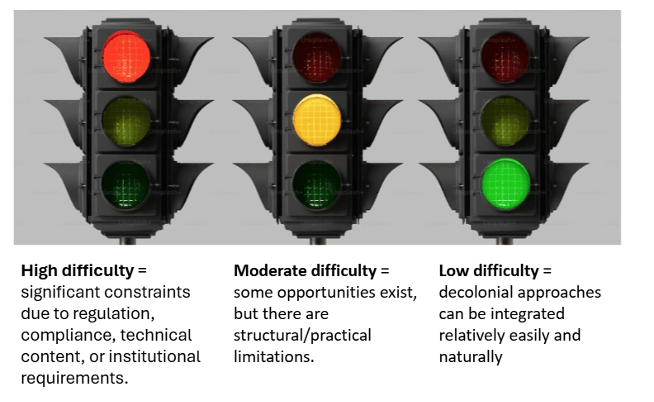
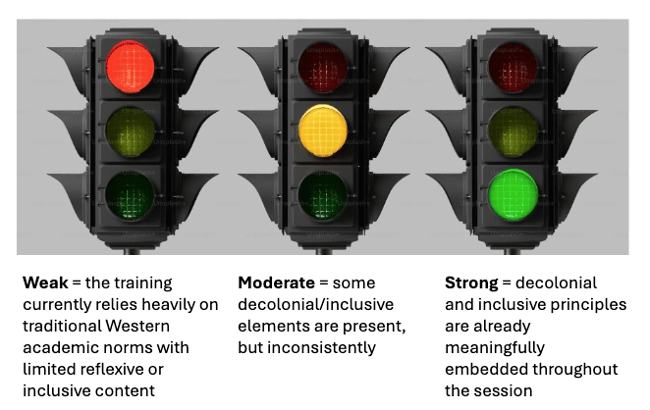
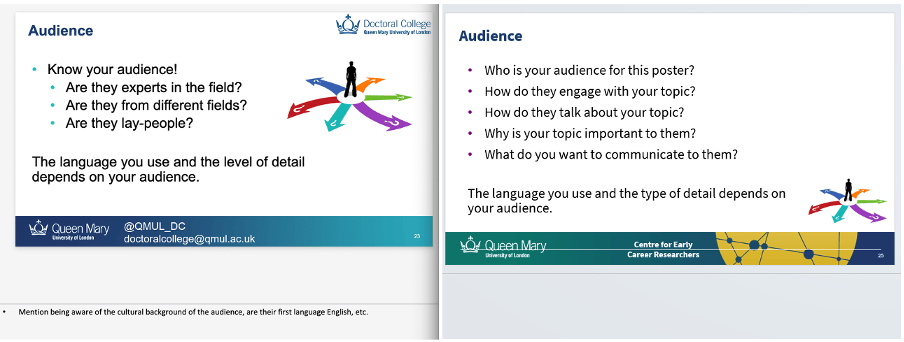
Next, we reviewed training materials, classifying them based on our traffic light system, and suggested specific recommendations to each training. An example of this is shown in figure 3.
Introducing our seven principles
Bringing together and reflecting on the recommendations generated through this review process, we developed seven principles to support the decolonisation of our training materials (figure 4). Our full Principles document is available for download (Principles white background PDF, Principles dark background PDF).
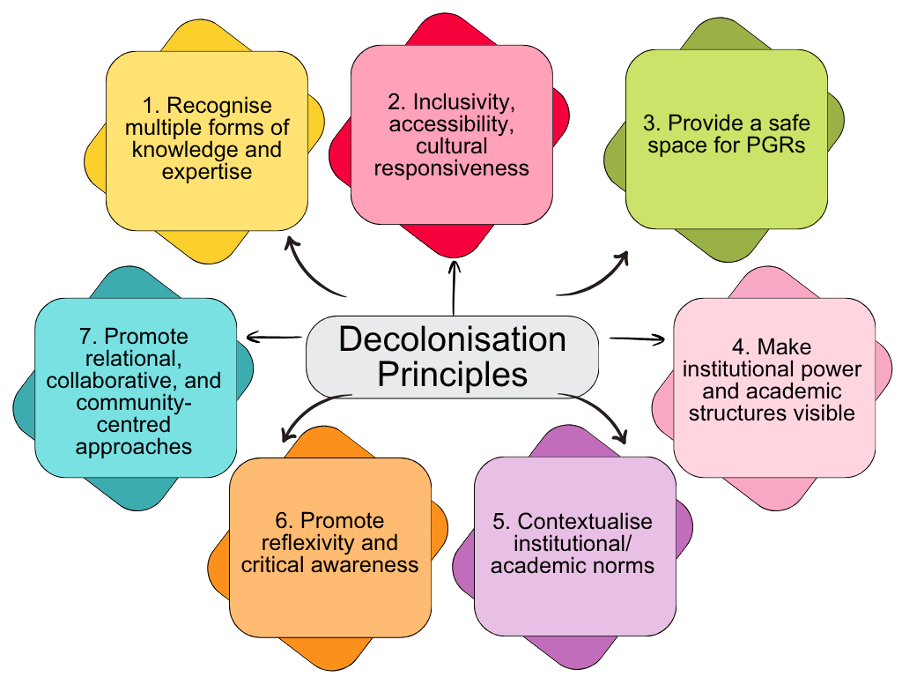
The principles are presented in approximate order of implementation difficulty, beginning with changes that can often be incorporated relatively easily into existing training and progressing towards broader cultural and structural considerations. We offer a set of questions under each principle to encourage reflection and critical evaluation of current PGR training resources and modes of delivery.
A framework for reflection rather than a checklist
Importantly, we do not view these principles as a prescription for what ‘decolonised’ researcher development should look like. There is a risk that decolonisation itself becomes reduced to an institutional checklist: include diverse examples, change a reading list, tick a box and consider the work complete. Instead, we view the principles and questions as prompts for ongoing reflection, dialogue and critical examination. The practical application of these principles will depend on the training, its purpose, its participants and its institutional and cultural context.
Our framework therefore provides a practical starting point rather than an endpoint. We encourage those involved in PGR development to ask whose knowledge is represented, whose voices are heard, which academic norms are presented as universal, and how training might better recognise different perspectives, experiences and ways of knowing.
Although the framework can be used on an individual basis, we encourage engaging with it collectively to promote discussion, challenge assumptions, and identify shared opportunities for improving PGR training. Suitable forums may include department meetings, teaching away days, staff development sessions, and informal conversations with colleagues. Crucially, those conversations should also include postgraduate researchers themselves. Rather than assuming what would make development activities more inclusive, researcher developers can create opportunities for PGRs to identify perspectives, experiences and issues they feel are absent from existing provision.
Our approach as a conversation starter
Decolonising PGR development is therefore not a one-off intervention or something that can be considered as ‘complete’. It is an ongoing and reflexive process of questioning established practices, listening to and centring different perspectives, and remaining responsive to changing contexts.
Our seven principles are one contribution to that process. We hope they provide a practical way for those involved in PGR development to start these important conversations, critically examine existing practice and consider what a more inclusive approach might look like in their own context.
We’d love to hear from others who are involved in PGR training, development, and delivery, as well as PGRs themselves.
We welcome feedback (both positive and critical) from colleagues and postgraduate researchers within and beyond QM. Please get in touch with us at: cecr@qmul.ac.uk.


Leave a Reply