Chris Sheridan, Director of Learning and Organisational Development, Digital Bricks, UK.
All careers are shaped by change. We develop new skills, respond to unexpected opportunities and make deliberate choices about our career pathways. Researchers and research professionals move between projects, collaborations and contracts within continually evolving structures. Across this ecosystem, many are already actively shaping aspects of their work, whether or not they recognise what they are doing as ‘job crafting’.
Job crafting describes the proactive ways people shape their work to create greater alignment with their strengths, values, interests and motivations. Rather than seeing job design as something determined solely by organisations, job crafting recognises that individuals influence their roles through changes to their tasks, working relationships and perceptions of their roles, known as task, relational and cognitive crafting, and which can improve individual and collective wellbeing in the workplace (Wrzesniewski and Dutton, 2001).
My interest in job crafting began with recognising it in my own ‘squiggly career’ (Tupper & Ellis, 2020), which led me to undertake qualitative research exploring how Coaching Psychologists (meaning both a practicing coach that uses psychological methods, and or a qualified psychologist that uses a coaching approach) shape their roles and what this might mean for their careers, coaching practice and their clients.
Later, working as a university People Partner for Research Culture, I became interested in research leaders whose non-linear career pathways illustrated how people continually reshape their work. Some had developed opportunities through collaboration, taken on responsibilities beyond their formal roles or encouraged others to explore new possibilities through informal mentoring. Their experiences prompted me to consider in this post whether job crafting could offer something useful to researcher development.
4R Job Crafting Model
Drawing on a review of the established job crafting literature and my own research project, I developed the ‘4R Job Crafting model’, to allow colleagues to engage with a structured reflective process comprising interconnected stages:
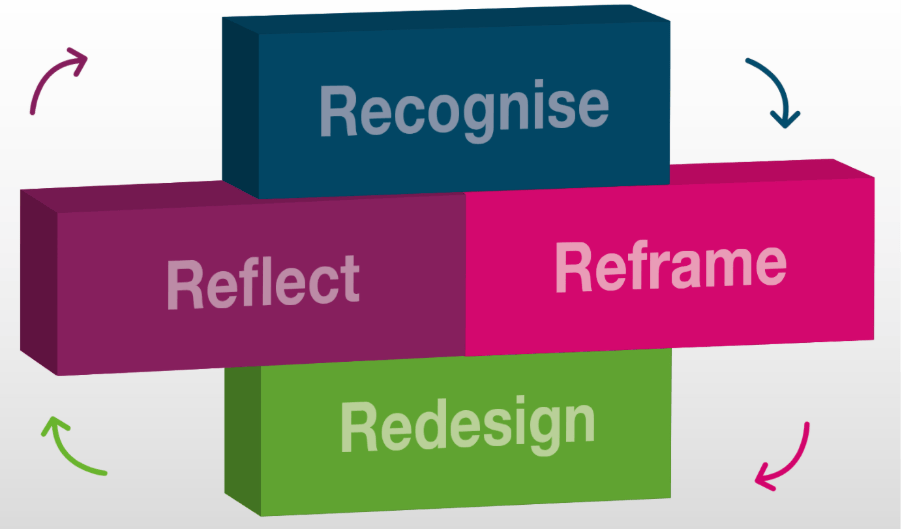
- Recognise: Explore current tasks, relationships, strengths, values and motivations, identifying what energises or constrains you.
- Reframe: Consider alternative perspectives on your role and its purpose.
- Redesign: Identify realistic, intentional changes to tasks, relationships or ways of working that could improve alignment with your personal and professional goals.
- Reflect: Review what has changed, what has been learned and whether further adjustments might be needed.
The stages are not necessarily linear. Job crafting can be an ongoing process of self-awareness, experimentation and adaptation as circumstances change. The model does not assume everyone has equal freedom to reshape their work. Instead, it provides an opportunity to explore where agency exists, where constraints lie and what changes might be possible.
Job crafting workshops and culture change
In 2026, I introduced the model through online learning and in-person workshops with the University of Dundee and the InFrame Project, a collaboration between the Universities of Glasgow, St Andrews and Edinburgh. Participants included researchers and research professionals working across different roles and grades.
The sessions explored how job crafting theory might translate into everyday working practices. Participants were encouraged to consider not only what they do, but why they do it, how they work with others and where opportunities for change might exist.
We began by looking at the changing landscape of work, particularly the uncertainty facing higher education. Financial pressures, restructuring and job precarity were candidly discussed which helped situate job crafting within the realities of participants’ working environments rather than presenting it as some kind of solution to sector wide challenges. In the sessions, we understood that our crafting was for our own empowerment and preparedness, whatever the future may hold.
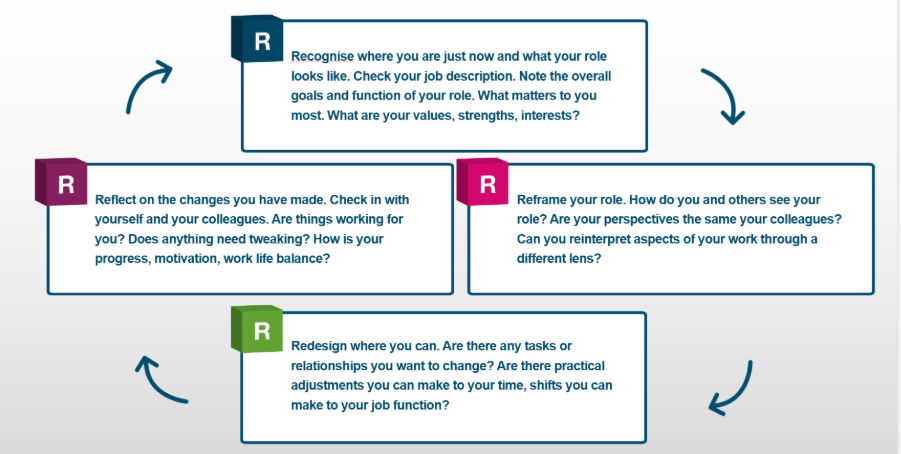
Participants then worked through activities based on the four stages, supported by an online learning resource (pictured below) that they could use independently while communicating with their colleagues if they wished.
Feedback and observations
One of the lessons I learned from these workshops concerned the language and context in which job crafting was introduced. The term ‘job crafting’ was unfamiliar to some and understandably raised questions at a time when universities were announcing savings targets including through potential redundancies. This highlighted the importance of explaining job crafting as a voluntary, bottom-up approach to exploring possibilities, rather than an organisational development or HR initiative.
Another observation was how much participants appreciated having protected time and space to think about their work. In busy research environments, opportunities to step away from demands and distractions to reflect on what matters, what is working and what might change can be increasingly limited. Informal feedback after the workshops suggested the opportunity for simple reflection was valuable in itself.
The workshops also created space for conversations about uncertainty, anxiety, priorities and possibilities – all before participants began exploring any potential changes.
This feedback led to me considering whether the conditions surrounding job crafting might be as important as the process itself. Providing structured activities is one aspect of crafting but creating an environment where people feel safe to reflect openly and explore their options dictates how effective that crafting is.
From individual agency to research culture
Job crafting is grounded in the idea that individuals can exercise agency in shaping their work. However, within complex research institutions, that agency can be influenced by traditional hierarchies, top-down practices and access to resources.
Individuals cannot solve issues with workload, precarity or inequalities by job crafting alone. Organisations also have a responsibility to create the conditions in which people have meaningful opportunities to influence their work. For researcher development, how then can we encourage individual agency while recognising constraints in the ecosystem that may shape people’s choices? The workshops suggested that feeling psychologically safe with protected time may be important starting points. The UK’s Researcher Concordat’s stipulation that researchers should all take part in 10 days of development per year acts in support of this protected and agentive approach (Concordat Strategy Group, 2019).
The 4R model offers a way to structure sessions that encourage individuals to consider what they can influence while recognising where wider organisational support may be needed. Over time, if organisations are open to learning from conversations and reflections arising from job crafting activities, this concept might also inform organisational practices and contribute to positive culture change.
Crafting the conditions for change
Careers will always involve a blend of chance and choice. Job crafting offers a practical way to explore those choices, but the ability to act on them depends on more than individual motivation.
Introducing the 4Rs into research environments has reinforced my belief that people need opportunities to reflect, explore possibilities and influence how they work, particularly during periods of uncertainty.
If we want to empower individuals and develop more positive research cultures, providing tools for job crafting is only part of the picture. We must also create the conditions in which people have genuine opportunities to shape their work.


Leave a Reply